

Fakafekauaga: The Philosophy of Servantship

Updated: 4 days ago
By Falahemotu and Makapatama, FakaFekauaga Catalyst (FFC)
Prologue – A gift from my Nena and Papa
The voices of my nena and papa echo stronger every day
Kaufakalataha ti moua e tau monuina — work together and we will be blessed.
I was born and raised in the village of Vaiea, Niue, by my Tupuna, my grandparents Makapa and Vailima Ikipe, alongside my sisters. Our mother left when we were very young for New Zealand, along with our uncles, to work and provide for us from a distance with money and parcels of clothes and food. From a young age, we were immersed in a way of life that emphasised love, village-community, interconnectedness and deep respect for both the people in our families and our environment.
It was through watching my nena and papa live this every day, in the way they tended our land, cared for our elders and quietly served our village without seeking recognition, that I first came to understand Fakafekauaga not as an idea but as a way of life, a philosophy founded and recalibrated over generations in Niuean family and village culture, lived and taught by many before them.
At the heart of our upbringing was an intrinsic understanding that thriving and survival were not individual pursuits but collective efforts made for the greater good, whether for our families, the entire village or generations yet to come. We were taught from early childhood to live as Tupuna-thinking children, aware that our actions would shape the lives of our family, our land and our grandchildren yet to come. Caring for those who would inherit the future was not just a responsibility but a natural way of living.
As an egalitarian society, where families and village are central to decision-making, life was grounded in shared responsibility, mutual care and the understanding that we were all Leveki, stewards and guardians of the land and of each other. This sense of collective living and future-facing responsibility was woven into every aspect of our daily lives, from the way we cared for our elders to how we nurtured the environment.
When I was ten, my grandparents, in their fifties, made a huge sacrifice to leave their paradise, everything they had known, loved and cared for: family, our village, our land. We moved to New Zealand seeking education and opportunity.
The transition was stark. We had to learn English, especially my poor nena and papa, and overnight adapt to a world deeply rooted in individualism. Words and phrases like “think for yourself”, “nuclear family” and “what did you do” rather than “what should we do” became the new norm. These terms, while not inherently bad, felt alien to me, especially coming from a place where the wellbeing of family, village, land and future generations was always at the forefront.
In New Zealand, the emphasis on individual success and autonomy never quite sat well with me. In Vaiea, we were taught that survival was not about individual achievement but about collective responsibility. Our elders instilled in us a deep sense of interconnectedness, not just with our immediate families but with the wider village-community, the land and Mokopuna generations yet to come. Our daily rituals and practices, whether in tutala or talanoa, work or sacred customs, continually reinforced this belief that we were all part of something bigger than ourselves and that our choices must protect and sustain life for those who follow.
Over time, I began to see how disconnected people could become from one another and from the land. Success was measured by personal achievement rather than collective thriving. This way of thinking felt out of alignment with the values I had grown up with, and it became clear that the philosophies of collectivism, interconnectedness and stewardship that shaped my upbringing in Vaiea hold wisdom the world deeply needs today.
Through my years of observing, learning, studying and working, I have come to understand that true success, whether personal or organisational, cannot be about individual gain alone. It must be about collective good and the ongoing evolution of relationships and community wellbeing. From this foundation, I bring forward the philosophy I hold dear, a philosophy founded in the same values I grew up with in Vaiea and continue to practise within my family, village communities and work here in Aotearoa New Zealand.
I am forever grateful to my late grandparents, nena and papa, whose lives and actions taught us by example what it truly means to serve, to live in harmony with others and to care for the land. It is because of their enduring love and influence, and in my role as Leveki, guardian and steward, that I carry forward this wisdom, mindful that we are always serving not just today’s generation but those who are yet to come.
What they carried continues to guide my understanding of Fakafekauaga, not as something simply to define or talk about, but something to live, nurture and share as part of a collective journey of service.
"Haaku lima e... haaku lima e! Tau ke tukuhake haaku magafaoa, Makapatama. Haaku akau e... haaku akau e! Tau ke tukuhake haaku maaga, Vaiea Fatiau Tuai. Haaku lima e... haaku akau e! Tau ke tukuhake a Niue....
Tau ki tua Tagaloa eee, tau ki mua Tagaloa ooo, mata ki luga Tagaloa, mata ki mua Tagaloa, monu, monu, monu ti tonu."
A chant of spiritual connection between family, village, spirituality and environment
Introduction - Kamataaga
We are living in a time of great paradox. Humanity has achieved extraordinary technological, scientific and material progress, yet our social, political, economic and environmental systems are straining under the weight of fragmentation, isolation and moral fatigue. We have become masters at building systems but less adept at nurturing them. Despite our abundance, disconnection has become a defining feature of modern life.
We are living in a time of great paradox. Humanity has achieved extraordinary technological, scientific and material progress, yet our social, political, economic and environmental systems are straining under the weight of fragmentation, isolation and moral fatigue. We have become masters at building systems but less adept at nurturing them. Despite our abundance, disconnection has become a defining feature of modern life.
Leadership models built on control and competition are no longer adequate for a world that demands cooperation, care and collective intelligence. Our tools for change, including strategy, policy and reform, remain largely technical while the deeper roots of imbalance lie in the erosion of relational and spiritual intelligence.
Traditional approaches to transformation rely heavily on hierarchy, frameworks and linear planning. These tools have their place, but they struggle to respond to the complexity and interconnectedness of the modern world. The crises we face, including climate change, inequity, inequality, burnout and loss of belonging, are not merely operational failures. Many are relational ones.
There is a growing call for a way of organising that renews our sense of responsibility to each other, the environment and future generations.
Fakafekauaga emerges from this need.
It offers something more fundamental than another tool or framework. It is a way of being, a philosophy born from Niuean village life that centres service, interconnectedness and stewardship in how we understand our responsibility to people, community and the environment. It challenges us to reconsider the emphasis we have placed on individual success, extraction and hierarchical control, and what becomes possible when collective wellbeing, care and relational responsibility are given greater weight.
This is not a call to return to the past but to rebalance and evolve the present. Fakafekauaga bridges ancestral wisdom and contemporary systems thinking, showing that ancient relational philosophies hold the keys to navigating modern complexity. It reminds us that survival and flourishing are not individual pursuits but collective responsibilities, founded in love, reciprocity, and reverence for life itself, mindful always of the generations who come after us.
In this seminal article, I bring Fakafekauaga into a wider conversation as the Philosophy of Servantship. A philosophy that redefines leadership and management, organisation, and community for a more interconnected and sustainable future.
As I have grown older, I have found myself returning more often to the things my nena and papa taught me without ever formally naming them. Much of what I now understand about service, responsibility and our relationship with others was already present in the life I experienced in Vaiea.
Fakafekauaga belongs within that lived knowledge. Its roots are much older than the contemporary leadership, organisational and systems challenges through which people may encounter it today. They are found within the relationships, responsibilities, practices and conditions of Niuean family and village life. What Falalahemotu and I have sought to do through FakaFekauaga Catalyst is articulate more fully what this philosophy carries and explore how it can continue to serve people in the world we now inhabit.
My own understanding has deepened through experience. I have worked within organisations and institutions, held formal leadership and governance responsibilities, studied different approaches to leadership, management and systems change, and worked alongside communities and people navigating complex challenges. These experiences have given me additional language, but they have also repeatedly taken me back to what I first learned in the village.
Human beings do not begin life as leaders, managers, professionals, employees or members of organisations. We begin in relationship. We receive care before we understand contribution. We inherit language, knowledge, values, land, histories, responsibilities and ways of relating that existed before us. As we grow, we begin contributing to those same relationships and eventually become responsible for conditions that others will inherit.
Fakafekauaga begins there, with the human being as a person who serves within an interconnected world.
This is why we express Fakafekauaga in English as Servantship. The English word provides an entry point, although it cannot carry everything contained within the Vagahau Niue expression. Fakafekauaga is concerned with how we live as people in relationship with one another, with our village, with knowledge, with the natural and spiritual worlds, and across generations.
The contemporary world gives us many sophisticated ways of organising ourselves. Leadership, management, governance, strategy, policy and systems thinking all have their place. Fakafekauaga begins further back, with the human relationships upon which all of those structures ultimately depend.
As Falalahemotu and I have worked to articulate Fakafekauaga, the Tia Lili, a circular Niuean weave, has become an important visual expression of this understanding. Its form reflects something I have found difficult to communicate through words alone: that the relationships within Fakafekauaga cannot be neatly separated from one another. They exist within a whole, connected through the weave while retaining their own form.
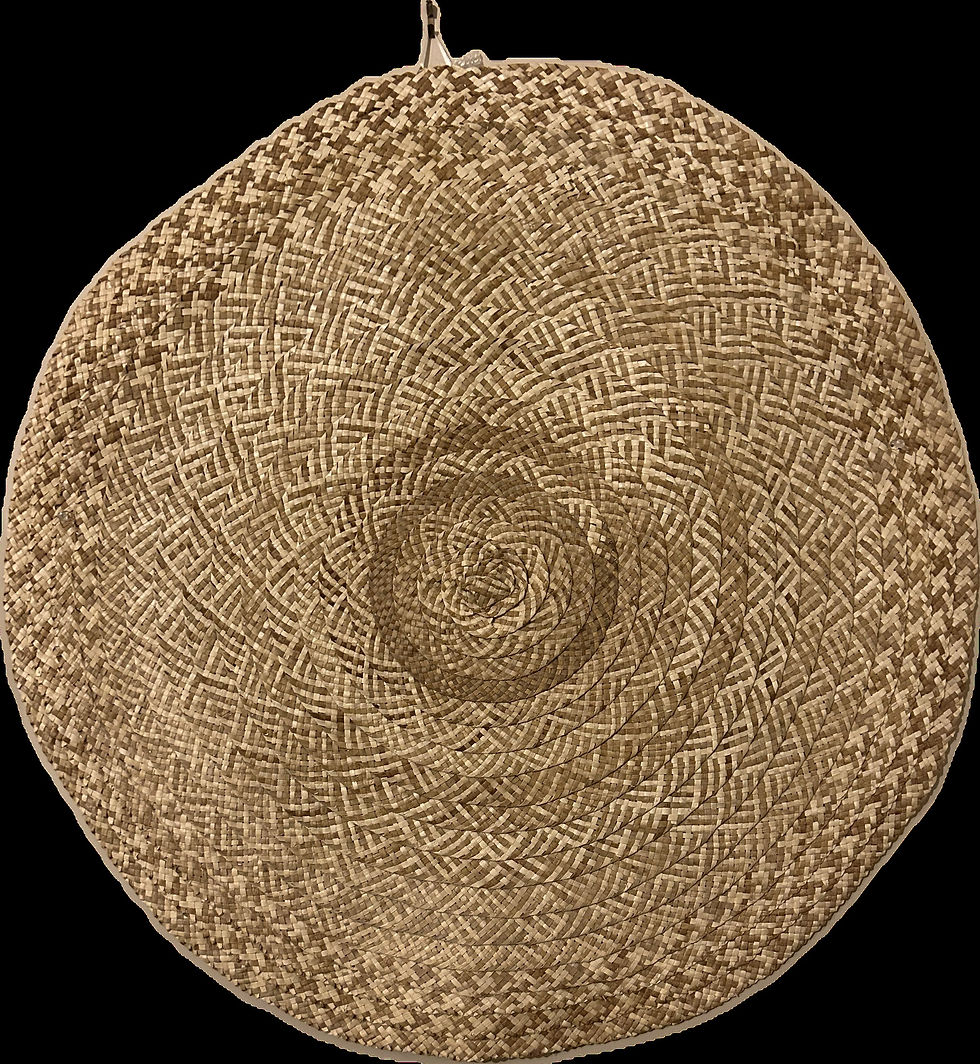
Tia Lili — a visual expression of Fakafekauaga
Its significance becomes clearer as we move more deeply into Fakafekauaga and the Five Core Human Characteristics.
Fakafekauaga – Servantship
The word Fakafekauaga carries meaning within Vagahau Niue that cannot be completely reproduced through a single English translation. We use Servantship because service sits at its centre.
The word can be understood through its parts. Faka speaks to making or doing. Fekau speaks to service. Aga speaks to the qualities and characteristics of the person. Together, these help us understand Fakafekauaga as more than the act of serving. It reaches into the qualities and conduct of the person and the way service is lived.
We define Fakafekauaga as:
“Ko e taofiaga faka-maaga, ko e puhala he moui kua fakave ke he fakafekau, matu-taki-aga faka-agaaga mo e moui-olaola; he tagata, maaga moe lalolagi katoatoa.”
“A village philosophy and way of being; rooted in service, interconnectedness, spirituality and survival, dedicated to advancing the greater good of individuals, villages and the planet.”
My grandparents did not need a formal position before they could serve. Their contribution to family and village did not depend upon a title, nor did service represent a pathway towards becoming more important than the people around them. They served because they were part of the village and understood the responsibilities that came with belonging to it.
Niuean village society developed differently from Pacific societies organised through hereditary chiefly structures. Family and village relationships carried responsibilities, knowledge, respect and different functions, but service did not need to culminate in an elevated social position. Collective life depended upon people contributing.
This matters when Fakafekauaga is brought into contemporary settings. Leadership, management, governance and other formal roles remain necessary. Communities and organisations need people who can make decisions, coordinate activity, carry accountability and contribute particular expertise. Fakafekauaga changes where we begin our understanding of those functions.
The servant exists before the role.
A leadership position is a function a person may hold in service of a collective purpose. At different times, the person best placed to hold that function may change according to the knowledge, expertise and circumstances required. Holding responsibility does not place that person outside or above the relationships upon which the collective depends.
This reflects something I experienced naturally in village life. Elders carried knowledge and responsibility and were respected for what they held, while their contribution remained connected to the life of family and village. Expertise mattered.. experience mattered.. responsibility mattered. The contribution of everyone else mattered too.
A person can live an entire life serving family, village, land and others without that service needing to culminate in a leadership title or elevated status. The significance of the life is already present in the contribution itself.
For me, this is one of the deepest meanings carried by Fakafekauaga.
Understanding Fakafekauaga
Service is sometimes understood as something we provide to another person. Within Fakafekauaga, the relationships involved are wider than the immediate interaction.
The person in front of us belongs to family, community, histories and future relationships. The decisions we make can affect people we may never meet. Our wellbeing also depends upon land, sea and ecological systems that cannot be separated from human life. Understanding who we serve therefore requires a much wider field of attention than the immediate beneficiary of an action.
The same is true of what we serve. Organisations, institutions and programmes can provide useful structures through which people contribute, but the structure itself is not necessarily the ultimate purpose. An organisation established to improve people’s lives exists because of the purpose it carries. If protecting the organisation becomes more important than the people or purpose for which it exists, service can become disconnected from its reason for being.
Service also has a relationship with time. There are moments when responsibility requires immediate action, particularly where people or the environment face harm. There are other circumstances where serving well requires anticipation: noticing what is changing, understanding consequences and acting before a problem becomes a crisis.
There are also times when contribution requires restraint. Helping can become harmful when it removes another person’s opportunity to contribute, creates dependency or ignores whether people are ready to receive what is being offered. Growing up in a village taught me that service was not simply doing everything for somebody else. People contributed according to their ability, knowledge, age and circumstance. We were part of one another’s wellbeing without taking away each other’s place within the collective.
How we serve therefore matters as much as the intention to serve. Relationships require listening, observation, humility, judgement and an awareness that we do not carry all the knowledge needed for every situation. Sometimes we contribute. Sometimes we receive. Often we are doing both at once.
This has become increasingly important to me as I have moved through different stages of my own life. I remain a Mokopuna because I am the grandchild of those who came before me. I am also a Matua, and I am now a Tupuna to my own Mokopuna. These relationships coexist. I continue to receive from what my grandparents taught me while carrying responsibilities for my children and grandchildren and contributing to the world they will inherit.
The reasons we serve are difficult to separate from belonging itself. Love, reciprocity, survival, responsibility and continuity are woven through the relationships that make human life possible. My grandparents served because there was family to care for, land to tend, knowledge to carry and a village whose wellbeing depended upon people contributing to one another.
That understanding sits at the heart of Fakafekauaga.

Core Human Characteristics
As Falalahemotu and I worked to articulate Fakafekauaga more fully, we came to describe five Uho Mahani he Tagata — Core Human Characteristics that help express the inner qualities through which Servantship is lived.
They are Matutakiaga, Mahuiga, Fakalofa, Fakamokoi and Matohiaga. Together they help us understand how Fakafekauaga takes form through the way we relate to one another, the values and knowledge we carry, our capacity for love and reciprocity, our relationship with the environment, and our responsibilities across generations.
Writing about them separately allows us to explore what each carries, but they should not be understood as independent traits or steps through which a person progresses. In lived experience they overlap continuously. Love affects reciprocity. Values influence how we understand relationships. Genealogy shapes responsibility. Interconnectedness changes how we see the consequences of our actions. The separation is useful for understanding; in life, these characteristics are woven through one another.
Matutakiaga - Interconnectedness • relationality • thinking as a system • systems evolution
Matutakiaga begins with relationship. Growing up in Niue, I did not experience people as separate from family, village and land. The relationships between tagata, magafaoa, maaga, fonua, moana, Tagaloa, Atua, the spiritual world and the wider environment formed part of the conditions within which life was understood.
One of the ways I understand Matutakiaga begins with my own birth. When I was born in Niue, my nena and papa carefully and firmly wrapped my placenta before burying it in our fonua. I was taught that the way it was wrapped mattered. It was to keep me safe and warm, a blessing for the beginning of my life and for the life ahead of me. They planted a plant above the place where my placenta was buried, and as I grew my nena and papa would watch how my plant was growing because its growth was seen as reflecting how I was growing. Caring for and observing the plant was connected to caring for and watching over me.
The return of my placenta to the fonua cemented my relationship with the land from the beginning of my life. It bonded us physically, emotionally and spiritually; we are one. The plant growing from that place was part of the same relationship, connecting my life with my family, my Tupuna and the fonua. This is why I cannot understand my relationship with land simply through residence or ownership. I left Niue when I was ten, but I did not leave that relationship behind. Physical distance does not undo what was established at my birth and continued through the care of my grandparents, the growth of my plant and my relationship with the place from which I come.
This way of understanding our relationship with the fonua also carries responsibility. Human beings are participants within the environment, and our wellbeing cannot be separated from the wellbeing of the fonua, moana and wider natural world. The spiritual world is part of this relationship too. The references to Tagaloa and Atua within Matutakiaga reflect a village life in which relationships were not confined to what could be physically seen or materially measured. Spirituality was present in our relationship with people and place, in village practices and in the chants I learned and continue to carry.
Years later, when I encountered systems thinking, I recognised something familiar within its attention to interdependence, relationships and consequences across a whole system. It gave me another language for thinking about patterns I already understood through village life. Matutakiaga goes further for me because these relationships are lived. They carry obligations, emotions, histories, spirituality and responsibility. What happens to one part of a village, organisation, ecosystem or family can move through the wider whole, and decisions made today can alter conditions experienced much later.
This is why Matutakiaga has become important in our work on thinking as a system and systems evolution. The contemporary language helps us communicate some of its implications, while the grounding remains relational and comes from a much older place.
Mahuiga - Values • ancestral knowledge • lived experience
Mahuiga concerns what we hold as important and the knowledge that shapes how we live.
My earliest lessons in values did not arrive as written statements. I learned by watching people. Fakatokolalo, humility, was evident in the way elders carried themselves and in how we were expected to behave in relationship with others. Fakalilifu, respect, was practised through how people were spoken to and treated. Kaufakalataha, working collectively, was part of village life itself. Loto fakaue, gratitude, fakamouina, blessings, and moui he Tagata, lived experience, were embedded within the way people understood and participated in life.
Fakatokolalo is a simple example of how these values were lived. Faka speaks to making or doing, and tokolalo to being low. If we walked in front of people who were sitting, or passed between them and what they were facing, we would say “tulou”, excusing ourselves as we passed, while at the same time lowering our body. The words were accompanied by the physical act of making ourselves low. Humility and respect were therefore not simply things we were told were important; they could be seen in how we carried ourselves and even in how we moved in relation to other people.
Practices such as this were part of how values became known to us. As children we watched, listened and participated, gradually learning what was expected and why it mattered. These values shaped a wider commitment to collective responsibility. They influenced how people related to one another, how responsibilities were carried and how family and village life was sustained. They were learned through participation and became meaningful through practice rather than simply being stated.
There was knowledge carried through elders, family practices, language, stories, observation and lived experience. Some of it could be explained directly. Other knowledge became understandable only through participation over time. The ancestral knowledge carried within Mahuiga is therefore more than information inherited from the past. It continues through people who practise, interpret and pass it on within the circumstances of their own lives.
Mahuiga gives that knowledge a place alongside the forms of expertise we encounter through education, professional practice and contemporary research. These knowledge sources do not have to compete with one another. What matters is understanding what each carries, whose knowledge is relevant and what may be lost when only one form of knowing is given authority.
This becomes especially important when serving people whose lives, cultures or experiences differ from our own. Humility requires us to recognise the limits of what we know. Respect requires us to make space for knowledge held by others. Fakatokolalo requires us to recognise what we do not know, fakalilifu requires us to respect what others carry, and kaufakalataha requires us to work with people rather than positioning ourselves as the sole source of knowledge or solution.
Values ultimately become visible through conduct, relationships and decisions. Mahuiga is lived when what we say matters to us can also be recognised in the way we treat people, look after our planet, carry responsibility and serve.
Fakalofa - Love • compassion • empathy
At the heart of Fakafekauaga is Fakalofa, a sense of love, compassion and empathy that extends from our relationships with people into our relationship with community and the environment. Fakalofa gives service a human orientation, where contribution is motivated by genuine care rather than external reward and where collective wellbeing depends upon our capacity to care for one another and the world upon which life depends.
I experienced Fakalofa first through family. The love my grandparents showed us was expressed through everyday acts: feeding us, teaching us, working for us, correcting us, caring for others, making sacrifices and eventually leaving Niue so that we could have opportunities they believed would strengthen our future. Their love was something we experienced through what they did.
I have also seen Fakalofa expressed through people who continued serving others throughout their lives. My father-in-law worked as a social worker into his eighties. What stayed with me was not simply the length of his service but the humanity with which he approached people. Service was relational and personal because the people being served mattered to him.
Love within Fakafekauaga is not simply sentiment. Caring for someone can require difficult conversations, boundaries and decisions that may not initially feel comfortable. Compassion requires attention to the dignity and circumstances of another person rather than assuming that good intentions are enough.
Love also extends beyond relationships between individual people. If our wellbeing is connected to family, community, fonua, moana and the environment, then Fakalofa influences how we care within all of those relationships. Care for people is inseparable from care for the conditions that sustain their lives.
There is also no need to pretend that serving brings nothing to the person who serves. Helping others can bring joy, belonging, purpose and fulfilment. I have experienced that myself. Fakalofa does not require the servant to disappear. The wellbeing of the person serving is also part of the relationships being cared for. What matters is that another person’s vulnerability is not turned into a means of elevating ourselves.
Fakamokoi - • Reciprocity — give and forget, but receive and remember always
One of the expressions that has stayed with me throughout my life is give and forget; receive and always remember. I learned what this meant by watching my nena. There were times when we had very little ourselves, yet she would still share what we had with other people. As a child, I did not always understand it because when there is not much to begin with, watching some of it being given away can be difficult to make sense of. But my nena shared because that was how she lived with others. You contributed what you could from what you had.
What I also remember is how she responded when people later came to our home bringing food or gifts for us. She could be shocked and emotional. She had not given to them expecting anything back and sometimes it seemed she had almost forgotten what she had done for them, yet when she received something from somebody else she remembered it. Watching her helped me understand the difference between the responsibility of giving and the responsibility of receiving. You give without keeping account of what you have done; when you receive, you carry gratitude for what somebody has done for you.
I remember my nena teaching us this across generations as well. She once told us about a family who had helped her and my papa when they needed it. As she told the story, she pointed towards their children and grandchildren, people of our generation, and told us not to forget them. We had not been part of the original act between our grandparents, and their grandchildren had not necessarily been part of it either, but that did not matter to her. She wanted us to know what their family had done for ours so that the gratitude did not finish with her and my papa. The memory of what had been received became something she passed to us.
This is how I came to understand Fakamokoi as something more than an immediate exchange between two people. It is not a ledger where what has been given creates a debt that must be repaid in equal measure to the same person. What I receive from one person may shape how I later contribute to somebody else, and what one generation receives can be remembered and carried forward through another. My nena’s story also shows why memory matters within reciprocity. She was not asking us to repay a debt on her behalf; she was teaching us to remember the relationships that had helped sustain our family and to allow that gratitude to influence how we lived with others.
Fakamokoi is reinforced through the rituals and everyday practices of village life. Tautala and talanoa, through storytelling and dialogue, allow experiences, skills, knowledge and histories to be shared, just as my nena used story to ensure that we knew what another family had done for ours. Fono, our gatherings and meetings, involve respectful two-way communication in which speaking and listening are both forms of contribution. Tapu recognises that our relationships with people, land, sea and the spiritual world carry sacred responsibilities, while Leveki, guardianship and stewardship, extends reciprocity into our relationship with the environment because we receive from the fonua and moana while carrying responsibility for their care and for what others will receive from them.
Fakaonoono and fakanogonogo, observing and listening attentively, are also part of how these responsibilities are learned. Much of what I came to understand about Fakamokoi was learned in exactly this way: watching what my nena and papa did, listening to the stories she told us, seeing how she responded when others gave to her and remembering what she asked us to carry forward. This is also why I resist dividing people permanently into those who provide and those who receive. People move between giving and receiving throughout their lives, and a person receiving support today may hold knowledge, strength, care or resources that become important to the collective tomorrow. We remain participants in one another’s lives, with the capacity to give and receive changing as our circumstances change.
Through these everyday practices, Fakamokoi became part of how families and the village sustained themselves. Giving, receiving, remembering, observing, listening and passing knowledge on were repeated across people and generations. A person who experienced generosity learned something about generosity, while a child who watched their elders share learned how people were expected to live with one another. Stories carried knowledge and gratitude forward, and everyday acts of service reinforced relationships and responsibilities within the family and village. In this way, Fakamokoi continued to replicate itself through practice rather than needing to be formally taught as a system.
I think of Fakamokoi as an invisible glue that helps hold the village together. It can be found in ordinary actions that may appear small when viewed separately, but collectively they help families and villages continue and thrive. People share food, knowledge, time, labour and care; they remember those who have helped them; they contribute when they are able; and what they learn through receiving is carried into how they later serve others. This movement helps sustain relationships, knowledge and everyday practices across generations. The village is strengthened because responsibility for its wellbeing does not sit with one person. It is continually reproduced through the way people live with and respond to one another.
For me, this is what sits behind give and forget; receive and always remember. My nena and papa showed me that gratitude can live beyond the original act and beyond the people who were part of it. What another family did for her and my papa became something she made sure their grandchildren and her grandchildren would know and carry forward.
Matohiaga - Ancestry • genealogy • past, present and future
Matohiaga connects us with those who came before us, how we live today and those who will come after us. In its simplest form, it is about taking the Mahuiga; the values, knowledge and learnings passed to us from our Tupuna and using them in our lives today while thinking about the generations who will follow us. Knowledge is passed forward so that each generation can draw from what has been learned before, apply it within the circumstances of their own time and contribute to what the next generation will receive.
My nena and papa taught me this through the way they lived and through what they passed to us. Their knowledge and values were never simply stories about the past. They were there to help us live. What I learned from watching them, listening to them and living alongside them continues to influence how I understand family, service, relationships, land and responsibility today. In turn, what Falalahemotu and I carry into our own family draws from what was given to us, together with what we have learned through our own lives.
Tupuna, Matua and Mokopuna help express this movement across generations. I remain the Mokopuna of my grandparents and continue to carry what they taught me. I am also Matua to my children and Tupuna to my grandchildren. These relationships exist together. What my Tupuna passed to me helps me live and carry my responsibilities today, while being conscious that what we do today will become part of what our children, Mokopuna and those after them receive.
Matohiaga does not mean that everything passed to us must remain unchanged. We have a responsibility to understand what our Tupuna have given us and exercise judgement within the circumstances in which we now live. Some knowledge and practices need to be protected and continued, others may need to evolve, and some things inherited from the past may need to end. Respecting our Tupuna includes taking seriously what they have entrusted to us rather than simply reproducing everything that came before.
This can be seen in our relationship with the fonua and environment. A tree planted by those before us may provide food or shade during our lifetime. What we plant and care for today may benefit people after we are gone. The same movement occurs with knowledge and values. We receive from those before us, use and care for what has been passed to us, add what we learn during our own lives, and pass something forward for others to draw upon.
For me, this is Matohiaga: the knowledge and values of yesterday helping us to live today, while remaining conscious of those who will live tomorrow. It was from this understanding within Matohiaga that we later developed the Tupuna to Mokopuna Multi-generational Weaving, applying these intergenerational responsibilities more deliberately to contemporary planning and decision-making.
The characteristics as a whole
The Five Core Human Characteristics form the living essence of Fakafekauaga. They are not separate traits operating independently. They are interwoven through the relationships between people, family, village, the natural and spiritual worlds, and generations.
Matutakiaga helps us understand the relationships within which we exist. Mahuiga carries the values, ancestral knowledge and lived experience that influence how we move within those relationships. Fakalofa brings love, compassion and empathy to how we care. Fakamokoi sustains reciprocal relationships through giving, receiving, remembering and contributing. Matohiaga carries knowledge and responsibility through generations, connecting what we receive from our Tupuna with how we live today and what our Mokopuna will eventually receive.
Even describing them separately can make them appear more distinct than they are in life. Caring for the fonua, for example, can involve Matutakiaga because we recognise our interconnectedness with the environment; Mahuiga because ancestral knowledge and values inform how we care for it; Fakalofa because care is grounded in love; Fakamokoi because we receive from the land and carry responsibilities towards it; and Matohiaga because what we have learned from those before us helps guide our care today while remaining conscious of those who will co
me after us.
The Tia Lili gives us a way of seeing this.
Tia Lili

As Falalahemotu and I continued to articulate Fakafekauaga, we looked for a way to tell its story that could hold together the relationships, values, love, reciprocity and intergenerational responsibilities we had described through the Five Core Human Characteristics. We chose the Tia Lili as a metaphor through which to tell that story.
The Tia Lili is a Niuean circular weave traditionally begun at the centre and woven outward, gradually forming an intricate relationship of strands, patterns and layers. Its form gave us a way to express something we understood about Fakafekauaga: although Matutakiaga, Mahuiga, Fakalofa, Fakamokoi and Matohiaga can be described individually, they are lived together and gain meaning through their relationship with one another.
Within the metaphor, the Tagata Fakafekau, the servant, is the weaver. The weaving begins from the commitment to serve and develops outward as the Tagata Fakafekau brings together the Five Core Human Characteristics through the lived practice of Fakafekauaga. The centre and the movement outward allow us to explain each characteristic while the completed Tia Lili allows us to see them as part of one intricate and interconnected whole.
The first layer is Matutakiaga. As the weaving moves outward, the Tagata Fakafekau recognises the relationships within which service takes place: tagata, magafaoa, maaga, fonua, moana, the spiritual world and the wider environment. We do not serve outside these relationships; we are participants within them. Like the strands beginning to form the Tia Lili, these relationships connect with and influence one another, changing and evolving over time.
The next layer brings Mahuiga into the weave. The Tagata Fakafekau carries the values and knowledge learned through Tupuna, elders, family, culture and lived experience. Fakatokolalo, fakalilifu, kaufakalataha and the other values carried within Mahuiga influence how the servant lives within those relationships, makes decisions and carries responsibility.
As the Tia Lili continues to grow, Fakalofa is woven through it. Fakalofa brings care into the way the Tagata Fakafekau serves. It is present in how we treat people, respond to their circumstances, nurture relationships and care for the environment upon which life depends. Love gives human meaning to the relationships and values already being woven.
Fakamokoi continues the weaving through giving, receiving and remembering. The Tagata Fakafekau contributes without keeping account of what has been given, while carrying gratitude for what has been received. Reciprocity sustains relationships because contribution does not move in only one direction. It moves between people, families, communities and generations, and extends into our relationship with the fonua and moana from which we receive and for which we carry responsibility.
The outward movement reaches Matohiaga; ancestry, genealogy and our relationship across generations. The Mahuiga, knowledge and learnings received from our Tupuna are carried into how we live and serve as Matua today, while remaining conscious of what our Mokopuna and those after them will receive. Within our Tia Lili metaphor, we described Matohiaga as the outer, never-ending layer because the weaving reaches beyond those currently making it. The threads and patterns of future generations cannot yet be known, but what we weave today becomes part of what they will receive and continue.
The layering gives us a way to explain the different characteristics and the movement of the weaving, but the Tia Lili also shows why they cannot be understood in isolation. Its strength and beauty emerge through the intricate relationships between its strands, patterns and layers. When we first articulated the layering, we described its order as a guide rather than a strict rule and recognised that in lived practice the weave remains dynamic.
The same is true of Fakafekauaga. Matutakiaga, Mahuiga, Fakalofa, Fakamokoi and Matohiaga do not switch on and off as the Tagata Fakafekau moves through the weave. They continually interact. Our values influence how we understand relationships and carry ourselves within them. Love shapes how we care and serve. Reciprocity influences how we give, receive and remember. What we have received from our Tupuna helps us live today, while our consciousness of our Mokopuna influences the responsibilities we carry in the present.
This is also why the Tagata Fakafekau as the weaver matters to the metaphor. The servant is part of the relationships being woven, bringing what they carry while also listening, observing, receiving, learning and being shaped by others. Like the master weaver, the Tagata Fakafekau works with the strands already present, attentive to their relationships while contributing their own hands to the continuing weave.
The Tia Lili brings the Five Core Human Characteristics back together after we have explored them individually. The layers help us see and understand each characteristic, while the intricate weaving shows us how they are lived together. Through the metaphor of the Tia Lili, Falalahemotu and I are able to tell the story of Fakafekauaga as we understand and live it: the Tagata Fakafekau is the servant and the weaver, bringing together interconnectedness, values and knowledge, love, reciprocity and responsibility across generations through the practice of Servantship. The weaving began before us, we contribute to it during our time, and it will continue through those who come after us.
Leveki – Our stewardship
Within Fakafekauaga, Leveki speaks to our responsibility as stewards and guardians. It is a responsibility we carry towards one another, our families and villages, the fonua and moana, and those who will come after us. It reflects an understanding that much of what sustains our lives was here before us and has been cared for by others. We receive the benefit of their knowledge, values, work, relationships and care, and during our own time we carry responsibility for what happens to what has been entrusted to us.
I learned this from my nena and papa long before I had words to describe it. They were Leveki through the way they lived. They cared for our family, tended the land, served the village, shared what they had and passed knowledge and values to us. They did not do these things because they occupied a formal position or because stewardship had been assigned to them as a role. Their responsibility came through their relationships with people, family, village and land, and through their understanding that what they cared for was connected to the wellbeing of others.
This understanding of Leveki also helps explain why Fakafekauaga is not centred on the elevation of the individual servant. The Tagata Fakafekau serves within a collective of relationships. At different times people may carry different responsibilities because of their knowledge, experience or what the circumstances require, but responsibility does not need to become permanent authority over others. The person holding responsibility serves a function for the collective and remains accountable to the relationships within which that responsibility is exercised.
Leveki also carries responsibility for the knowledge and values passed to us. What our Tupuna give us is not simply something to remember or preserve untouched. We have to live with it, understand it and exercise judgement within the circumstances of our own time. Some things need to be protected and continued, others will evolve, and there may also be things inherited from the past that should not continue. Our responsibility is to know what we carry, respect where it comes from and remain thoughtful about what our actions will leave for others.
The same responsibility extends to the fonua, moana and the wider environment. We live from things we did not create. Land, water, food and ecosystems sustain us, just as previous generations have contributed knowledge, relationships and resources that make our lives possible. Being Leveki means recognising ourselves as participants within these relationships rather than owners standing apart from them. What we take, use, protect, restore or neglect becomes part of the conditions in which others must live.
For Falalahemotu and I, articulating Fakafekauaga also carries this responsibility. We are sharing something grounded in Niuean family and village life and in knowledge that was lived long before we began writing about it. We do so as people who have received from others, particularly our Tupuna, families and communities. Our responsibility is to honour what has been given to us while allowing Fakafekauaga to speak to the world in which we now live.
This is the responsibility of Leveki as we understand it: to care for what has been entrusted to us, to serve well during the time that it is in our hands, and to be conscious of what others will eventually receive from the way we have lived.
Fakaotiaga – Conclusion
I began with my nena and papa because my understanding of Fakafekauaga begins with them and the village life in which they raised me. I watched them work the land, care for our family and elders, share what little we sometimes had, contribute to our village and make sacrifices for those they loved. They taught through what they did, and much of what I have come to understand about service was already present in those ordinary experiences of growing up with them in Vaiea.
Fakafekauaga gives Falalahemotu and me a way of articulating this philosophy of Servantship and sharing it with others. It begins with the Tagata Fakafekau, the servant, but the servant is never understood alone. We exist within relationships with family, village, land, sea, the spiritual world and generations. To serve is therefore to recognise those relationships and the responsibilities that come with being part of them.
The Five Core Human Characteristics help us express the qualities through which this way of being is lived. Matutakiaga grounds us in interconnectedness and relationship. Mahuiga carries the values, ancestral knowledge and lived experience that guide us. Fakalofa brings love, compassion and empathy to the way we serve. Fakamokoi sustains relationships through giving, receiving, gratitude and remembering. Matohiaga connects what our Tupuna have passed to us with how we live today and what those who come after us will eventually receive. They have been described separately in this article so that we can understand what each carries, but, like the Tia Lili, their meaning is found in how they are woven together.
The Tia Lili became the metaphor through which Falalahemotu and I could tell this story of Fakafekauaga. The Tagata Fakafekau is the servant and the weaver, bringing the Five Core Human Characteristics together through the way they live and serve. The layering helps us understand the different parts of the weave, while its intricate pattern reminds us that none exists independently of the others. The servant is also part of what is being woven, shaped by relationships while contributing to their strength and continuity.
Fakafekauaga comes from a particular place, people and way of life, but the human responsibilities within it reach into questions that concern all of us: how we live with one another, how we care for the environments that sustain us, how we use what has been entrusted to us and what we pass to those who follow. Sharing Fakafekauaga is our contribution to those conversations, grounded in the knowledge and experiences from which it comes.
The world my Mokopuna will inhabit will not be the world of my nena and papa, nor will it be the world Falalahemotu and I live in today. Yet I can still hear the words my grandparents gave us:
Kaufakalataha ti moua e tau monuina — work together and we will be blessed.
Those words travelled with us when we left Niue and have remained with me throughout my life. They carry the simplicity and strength of what my nena and papa taught us: that our lives are connected, that we have responsibilities to one another, and that what we do during our time matters beyond ourselves.
Fakafekauaga is the gift they gave me. Falalahemotu and I offer it forward in the same spirit in which it was received: through service.
Connect with us
If the philosophy of Fakafekauaga speaks to you, or if you're curious about how this collective way of being can enrich your community, organisation or personal life, we invite you to connect with us. Fakafekauaga offers a powerful philosophy for fostering interconnectedness, sustainable stewardship and collective well-being.
To learn more or engage with our work, please visit our website at fakafekauagacatalyst.com or email us at info@fakafekauagacatalyst.com. Together, let's explore how this village philosophy can inspire a more compassionate, just and sustainable world for our children.
Fakaue lahi mahaki - Our gratitude and acknowledgment
In our Niuean oral culture, knowledge acquisition is deeply rooted in the tradition of observing our elders engaging with one another and our environment, gathering around our matua (parents) and tupuna (elders/grandparents) and attentively listening to their stories. Through this immersive experience, we each embark on a personal journey of sense-making, receiving and embracing the wisdom shared in these dialogues, known as tutala/talanoa.
In a departure from the rigid conventions of Western academic writing, where referencing and quoting are paramount, we intentionally embrace a more fluid approach, returning to our oral and cultural traditions. While acknowledging the great influence of specific elders or individuals who have shaped our thinking, we invite you to embark on your version of tutala/talanoa by engaging with the written works left behind by these wise sages. In simple terms, read them yourselves or seek out their audience to listen and derive your own meaning. By doing so, as we have done, you can forge a connection with their wisdom, assimilate knowledge and craft your own unique interpretations. We believe this process will empower you to cultivate a deep understanding, encapsulating the essence of tutala/talanoa while fostering an appreciation for the diverse perspectives available to us in our villages, communities, cities and worldwide. And so, we offer heartfelt gratitude and deep appreciation in humble tribute to the revered elders and invaluable individuals below who have influenced our emotional and intellectual landscape, instilling wisdom and guiding our pens to express our thoughts and interpretations of their multi-layered insights:
First and foremost – all of our magafaoa (families) and elders (matua/tupuna).
FakaFekauaga Catalyst™ (FFC) – All rights reserved.
All content on this website is the intellectual property of FakaFekauaga Catalyst (FFC) and may not be copied, reproduced, or distributed without permission.


Comments