

The Five Questions of Servantship

Updated: 3 days ago
Falalahemotu F.N Makapatama and Makapatama (George), FakaFekauaga Catalyst (FFC)
Building on our earlier reflection, From Leadership to Collective Living Systems, this article formalises Fakafekauaga as a paradigm of service and opens a structured series of applied servantship inquiries.
Kupu Matutakiaga – Opening insight / reflection
Conventional leadership frameworks are struggling to keep pace with complexity, interconnectedness, and intergenerational challenges. Fakafekauaga, a Niuean village philosophy, offers a distinct organising logic that shifts focus from individual leadership to collective service, relational accountability, and stewardship across people, communities, and the environment. Across organisations and communities, leaders and teams are feeling the limits of traditional approaches.

Kamataaga - Introduction
Today, complexity is the norm. Climate disruption, social inequity, fragmented communities, and rapid technological change have placed responsibilities on leaders that no single person can carry alone. Effort, capability, or resilience alone cannot resolve these challenges. The deeper issue is the organising logic itself: leadership as a paradigm is increasingly misaligned with the interdependent systems it is meant to stabilise.
At FakaFekauaga Catalyst (FFC), we believe the way humans organise, serve, and share responsibility must evolve. What is required is not another leadership style, metric, or performance cycle, but a distinct organising logic that centres service, relationality, and collective wellbeing. This is the logic of Fakafekauaga.
“Ko e taofiaga faka maaga, ko e puhala he moui kua fakave ke he fakafekau, matu taki aga faka agaaga mo e moui olaola; he tagata, maaga moe lalolagi katoatoa.” “A village philosophy and way of being; rooted in service, interconnectedness, spirituality and survival, dedicated to advancing the greater good of individuals, communities and the planet.”
At its deepest level, Fakafekauaga exists for one central purpose: to ensure the survival and thriving of the village and its people through time. The village looks after each other and the environment not as an optional ethical choice, but as a necessity for continuity, so that future generations may live, belong, and flourish. Ethics, service, spirituality, interconnectedness and reciprocity are inseparable from this purpose.
Fakafekauaga Servantship is anchored in five interrelated core human characteristics:
Matutakiaga – Interconnectedness, relational, thinking as a system and systems evolution is seeing how people, communities, and systems are linked physically and spiritually.
Mahuiga – Values-based living, ancestral knowledge, lived experience: the practice of living a values-based life, grounded in humility, respect, gratitude, and servantship, using ancestral wisdom to nurture harmony, self-awareness, and purposeful relationships within families and communities.
Fakalofa – Love, compassion and empathy: the practice of serving and supporting others with love, compassion, and empathy, fostering harmony and wellbeing for individuals and communities.
Fakamokoi – Reciprocity – Give and Forget but Receive and Remember Always: the practice of reciprocal giving and receiving, fostering generosity, gratitude, and intergenerational connectedness.
Matohiaga – Genealogy – contextualised - past, present and future: honouring ancestral wisdom to preserve and guide cultural heritage for present and future generations.
Together, these characteristics articulate a holistic, relational, and intergenerational worldview, guiding how people, organisations, and communities serve one another.
Beyond traditional paradigms
In our seminal article, Fakafekauaga: The Philosophy of Servantship, we explored the limitations of familiar models of organisational life. Traditional archetypes such as the entrepreneur, the manager, and the leader, each offering distinct strengths in certain contexts, remain valuable for specific functions. However, they do not fully address the complex, interconnected systems in which contemporary organisations now operate.
Recognising this, Fakafekauaga is introduced not as another leadership model but as a separate paradigm, The Fourth Archetype that stands outside and alongside conventional categories, rooted in collective service rather than individual performance.
A definition alone, however, cannot fully convey the meaning of Fakafekauaga. To understand Servantship more deeply, we need to return to how it was understood and lived within the village: how we served, who we served, what we served, when we served, and why we served. These Five Questions are therefore not simply questions about service. Together, they help reveal the meaning of Fakafekauaga itself, taking us beyond its definition and into the relationships, responsibilities, values and ways of being through which Servantship was lived.
Fakafekauaga asks organisations and those who steward them to hold a different set of organising questions at the heart of their growth, strategy, and vision. These are not reflective add-ons or ethical afterthoughts. They are formative questions that shape what kind of organisation is being built, what kind of future is being pursued, and what kind of people leaders must become in order to steward responsibility well.
Held seriously, these questions have the capacity to shape organisational strategy, inform organisational philosophy, and guide the personal development of executive leaders and stewards of responsibility.
In this way, Fakafekauaga weaves inner formation and outer structure into a single organising logic of service. The Five Questions through which we explore the meaning of Servantship are:
How do we serve?
Who do we serve?
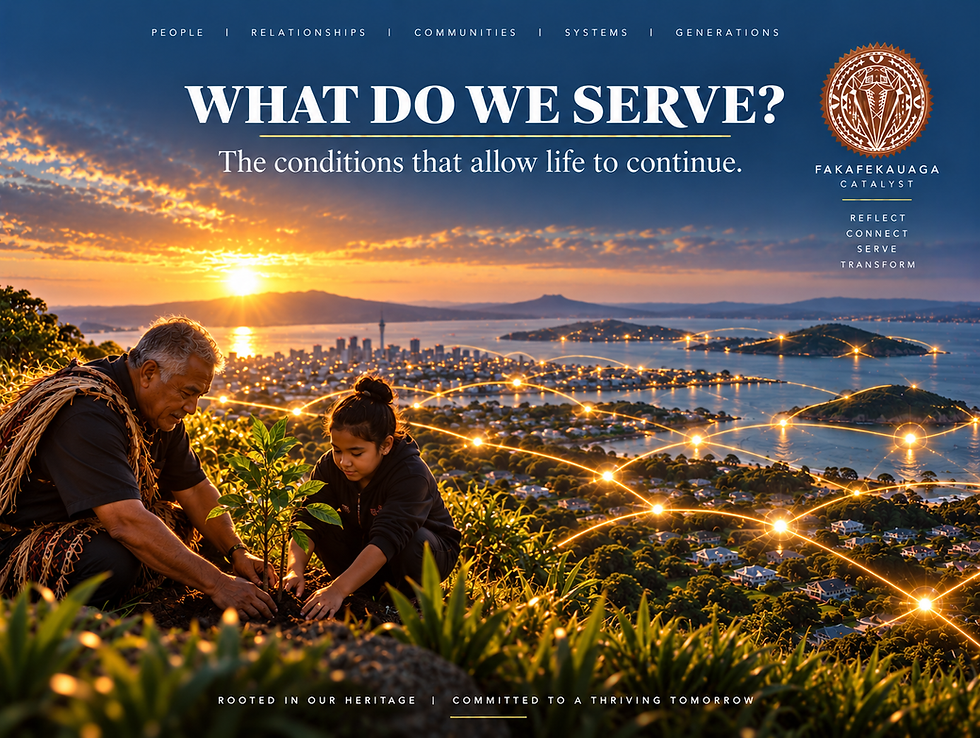
What do we serve?
When do we serve?
Why do we serve?
Where leadership frameworks tend to centre the individual, Fakafekauaga centres the collective and the relational field. Power, accountability, resource allocation, and care become explicit and negotiable. Development shifts accordingly. Leaders grow not by accumulating authority, but by learning to steward complexity. Teams mature through shared responsibility, and strategy becomes less about control and more about contribution within living systems.
This approach emphasises:
Interconnectedness over isolation
Collective wellbeing over individual achievement
Relational stewardship over hierarchical control
Intergenerational responsibility over short-term gain
A new story of service
Fakafekauaga invites you to see service not as an occasional action, but as a way of being. It is grounded in how we relate, whom we serve, what we prioritise, when we act, and why we commit ourselves to a course of care for others and our planet. This perspective reframes impact from quantifiable outputs to the health of relationships and our planet, the continuity of communities, and the sustenance of future generations.
This series of reflections begins with How do we serve? and moves through What, Who, When, and Why. It invites leaders, teams, organisations and communities not just to think differently, but to experience service in ways that honour cultural depth, ecological integrity, and intergenerational equity.
How to engage with this series
Each article will:
Distil a fundamental question anchoring Fakafekauaga’s philosophy and worldview,
Explore it through the lens of its Five Core Human Characteristics,
Offer space for collective reflection rather than prescriptive solutions,
Invite participation in a deeper understanding of service.
Service in Fakafekauaga is measured not by numbers or metrics, but through relational reflection, dialogue, and shared responsibility. These practices embodied in the Niuean traditions such as fono (meeting/gathering) and woven into the rhythms of everyday community life.
Welcome to the series — A journey into collective stewardship
Let us fofola e potu, roll out the mat, and begin with the first reflection: How do we serve? May these questions travel beyond words and into everyday practice of living Fakafekauaga every day, from boardrooms to communities.
Fakafekauaga therefore is not an alternative model of service, but a return to what has always already been true for us as indigenous village people. Before systems defined roles or institutions formalised responsibility, life was already being sustained through relational obligation between people, our land, sea and time. What we call Fakafekauaga - servantship is simply the recognition of this condition. And within that recognition lies a single responsibility that continues across generations: to ensure that the village remains whole, sustained, and alive in the way it carries people, land and the future.
This article is part of The Fakafekauaga Servantship Series — exploring Fakafekauaga as a living systems paradigm for servantship, collective stewardship and intergenerational responsibility.


Comments