

How Do We Serve?

Updated: 2 days ago
By Falalahemotu Makapatama and Makapatama (George) Founders and Leveki – Guardians and Stewards of Fakafekauaga-Servantship, FakaFekauaga Catalyst (FFC) www.fakafekauagacatalyst.com
Kupu Matutakiaga – Opening insight / reflection
Organisations frequently approach service as a task to be completed, a program to be delivered, or a metric to be achieved. Fakafekauaga reframes service not as an output, but as a way of being — a Niuean village philosophy of servantship that shapes how we relate to people, place, time, and responsibility. Stewardship is one natural expression of Fakafekauaga. Other elements, such as interconnectedness, reciprocity, and care, flow from this living philosophy.
This reframing echoes what Ronald Heifetz describes as the shift from technical performance to adaptive leadership: the movement from solving discrete problems to transforming the values, relationships, and responsibilities that shape collective life (Heifetz, 1994; Heifetz, Grashow & Linsky, 2009). Yet Fakafekauaga goes further, grounding this adaptive posture not in managerial competence but in ancestral, relational, and intergenerational ethics.
Leadership matures when it releases performance and embraces stewardship.
Leadership, in this view, does not mature through performance alone; it matures through collective responsibility and servantship. This reflection builds on the foundation established in Fakafekauaga – A New Paradigm of Service, which introduced Fakafekauaga as a Niuean village philosophy of collective stewardship, relational accountability, and intergenerational service. Here, we turn from paradigm to practice by engaging the first of five guiding questions: How do we serve?
This shift marks a movement from conceptual grounding to applied leadership inquiry, exploring not only what we do, but who we are and how we act within the relational weaving of people, place, and future generations.
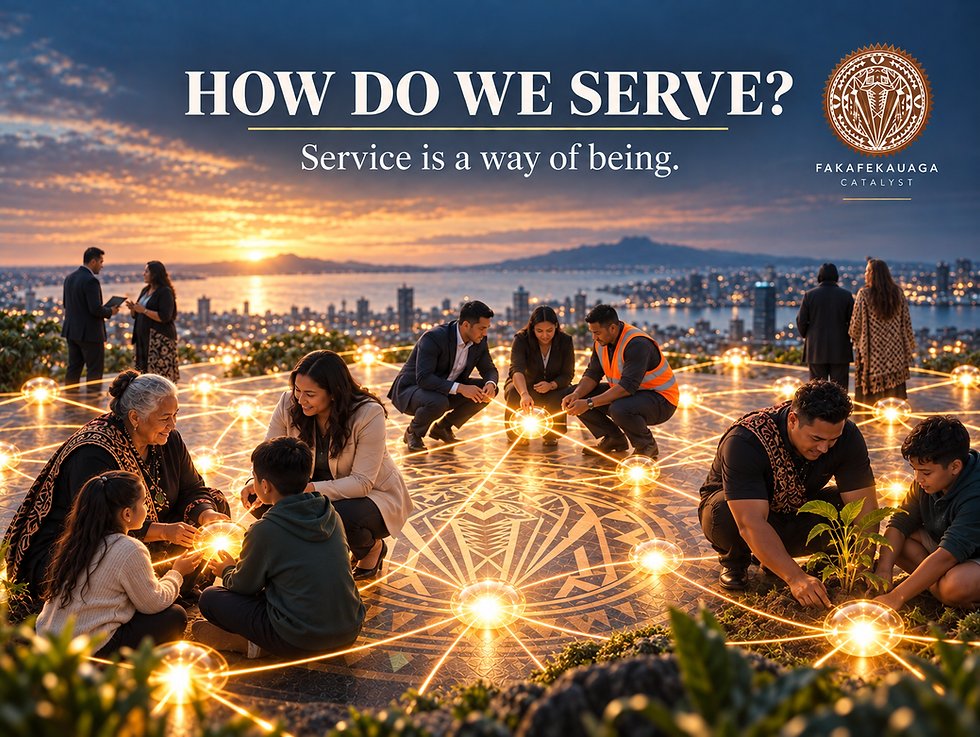
A Fakafekauaga Reflection — Tutala 1 of the Servantship Series
In many contemporary organisations, service is framed primarily as something we do: a program delivered, a value articulated, or a role assigned. Yet even amid refreshed leadership models, new strategies, and renewed commitments, leaders often sense that something essential remains absent. Effort has intensified, capability has expanded, and intentions are sincere, yet the strain persists.
From a Fakafekauaga perspective, this tension arises because service is not first an action. It is a way of being. It reflects how we stand in relationship to people, place, time, and responsibility. Before asking why or who we serve, Fakafekauaga invites a more foundational question:
How do we serve?
This question does not operate merely as a philosophical prompt; it functions as a diagnostic entry point into leadership practice.
This foundational question parallels Peter Senge’s conception of organisations as living systems rather than mechanical instruments, where learning, responsibility, and shared meaning precede performance (Senge, 1990). Fakafekauaga, however, situates this systems logic within Indigenous epistemology rather than managerial abstraction.
In Fakafekauaga, how we serve is informed by Tupuna (ancestors or the grandparent generation), Matua (the parent generation), and Mokopuna (future generations). This temporal ethic ensures that actions taken today uphold the wellbeing of generations yet to come. Service thus becomes a way of holding time itself with care, what Elinor Ostrom would recognise as long horizon stewardship of shared resources across generations (Ostrom, 1990).
Service is a privilege
Fakafekauaga is often translated as “servantship,” but this translation only gestures toward its deeper meaning. Fakafekauaga is a village philosophy and a way of being, grounded in service, interconnectedness, spirituality, and survival. It does not emerge from hierarchy or individual authority, but from collective responsibility.
This conception aligns with Ostrom’s rejection of top-down governance models in favour of commons-based, community-anchored stewardship systems where legitimacy arises from shared responsibility rather than positional power (Ostrom, 1990).
Service is not performed upward or downward. It is neither transactional, conditional, nor episodic. It is relational, reciprocal, and continuous. How we serve is revealed not by titles, roles, or stated intentions, but by how decisions are held, how power is exercised, and how responsibility is shared.
This mirrors Amy Edmondson’s findings on psychological safety: that trust, dignity, and mutual accountability, not hierarchy, determine whether collective systems can learn, adapt, and endure (Edmondson, 2018).
Together, these perspectives suggest that service operates as an organising principle, not a discretionary behaviour.
The relational system of service
Within Fakafekauaga, service begins with Matutakiaga, the recognition that people, families, communities, land, sea, spirit, and future generations exist within an interconnected living system. Nothing stands alone; every action ripples outward.
This relational ontology closely parallels systems thinking (Senge, 1990) and complexity leadership theory, which emphasise that outcomes emerge from patterns of interaction rather than from individual control.
This shifts the leadership focus from isolated decision-making to relational consequence.
To ask How do we serve? is to ask:
How do our decisions affect relationships, not just outcomes?
How do our systems honour connection rather than fragmentation?
How do we recognise responsibility beyond the boundaries of role, function, or sector?
Service is never directed toward an abstract mission alone. It is enacted within a relational field that includes those present, those absent, and those yet to come: Tupuna, Matua, and Mokopuna. This expands the stakeholder frame beyond current actors, echoing intergenerational governance models increasingly discussed in sustainability scholarship (Raworth, 2017; Ostrom, 1990).
Humility
Mahuiga, or values-based living grounded in ancestral knowledge and lived experience, reminds us that service begins with humility. In Niuean village life, humility is not weakness; it is discipline. It acknowledges that no one stands above the collective and that wisdom is distributed, not possessed.
This directly resonates with Heifetz’s principle that leadership is not authority and that authority-centred models fail when adaptive work is required (Heifetz et al., 2009). Fakafekauaga similarly exposes the limits of command based leadership in relational systems.
When organisations ask How do we serve? through Fakafekauaga, they notice the limits of authority-centred models. Decisions are no longer justified solely by position or mandate, but by alignment with shared values, collective wisdom, and long-term wellbeing.
Service restrains ego and recentres responsibility.
This reframes authority from a source of control into a vessel of care.
Love
Fakalofa — love, compassion, and empathy — is often misunderstood in organisational contexts as soft or optional. Within Fakafekauaga, it is neither. Fakalofa stabilises systems and allows them to endure.
This aligns with Edmondson’s research showing that compassion, dignity, and relational trust are not sentimental add-ons but structural conditions for high-performing, adaptive teams (Edmondson, 2018).
Serving well requires the courage to care, even when care complicates efficiency or exposes difficult trade offs. It demands attentiveness to who is being strained, silenced, or sacrificed in the name of progress. Asking How do we serve? invites organisations to confront the emotional and relational consequences of their strategies, not as afterthoughts, but as central considerations.
Care, in this sense, becomes a leadership infrastructure rather than a personal preference.
Reciprocity and accountability
Give and forget but receive and remember always.
Fakamokoi, or sacred reciprocity, shapes how service circulates for the greater good of the village. One gives without keeping score and receives with lasting memory of gratitude. Accountability is relational rather than punitive. It is sustained through remembrance, story, and collective reflection.
This reframing parallels Ostrom’s insight that durable governance systems rely on social norms, mutual monitoring, and shared narratives rather than formal enforcement alone (Ostrom, 1990).
Service is measured not by extraction or accumulation, but by balance. Where imbalance appears, restoration becomes a shared responsibility. This reframes accountability away from individual blame and toward collective stewardship, echoing restorative justice models increasingly adopted in organisational governance (Edmondson, 2018).
Accountability thus becomes a practice of restoration, not merely regulation.
Service across time
Matohiaga — genealogy and ancestry — reminds us that service is never confined to the present moment. Every act of service is observed by those who came before and passed on to those who will follow, our children, our grandchildren, and their children.
In Fakafekauaga, how we serve is inseparable from the legacy we leave. Service becomes a way of holding time itself with care, ensuring that our actions contribute to the flourishing of future generations. This renders service not only a moral posture, but a governance responsibility.
If legacy is real, then growth, strategy, and vision can no longer be neutral technical exercises; they become acts of stewardship in themselves, precisely what sustainability economists and long-horizon governance theorists now argue (Raworth, 2017; Ostrom, 1990).
This frames leadership as a form of time-binding responsibility rather than short-cycle optimisation.
Evolving through reflection to stewardship practice
Through Fakafekauaga, growth is no longer defined by scale, output, or dominance. It becomes the deepening of relational capacity: trust, reciprocity, shared responsibility, and collective resilience. Organisations grow not by becoming larger machines, but by becoming better ancestors.
This directly complements Senge’s definition of learning organisations as those that build collective capacity for seeing, relating, and acting systemically (Senge, 1990).
Strategy shifts from control and optimisation toward care and stewardship. Decisions are tested not only for efficiency, but for relational impact. Who is strengthened? Who is strained? Who carries invisible costs? Strategy thus becomes an ethical and relational design discipline rather than a purely technical one.
Vision is no longer a distant slogan. It becomes a lived orientation in the present, a commitment to holding responsibility in ways that future generations would recognise as just, wise, and generous.
A practical starting discipline is the Alignment Check. Before any major decision, leaders pause and ask collectively:
Are we acting from performance or stewardship?
What ethos are we embodying toward people, place, and future generations?
What would it look like to choose care over convenience here?
This is not merely reflection. It is a leadership control point, a way of governing growth, strategy, and vision through relational accountability rather than extraction logic, an applied form of what Heifetz would call adaptive regulation (Heifetz et al., 2009).
This transition marks the movement from reflective inquiry into developmental capability.
Is this a capability you are actively developing?
While Fakafekauaga is first and foremost a philosophy of being, its core human characteristics and principles can be cultivated in organisational life. The development of stewardship capability, the capacity to hold authority with humility, govern through care, and make decisions accountable across generations, is one practical expression of living Fakafekauaga.
Many leaders will read this reflection and recognise its ethical coherence. The language of stewardship, care, intergenerational responsibility, and relational accountability resonates with what a growing body of leadership scholarship now identifies as necessary for navigating complexity, fragility, and long-horizon risk.
Yet recognition is not the same as capability. Fakafekauaga functions not primarily as a moral appeal but as a diagnostic lens exposing the gap between what leaders espouse and what their systems are structurally designed to produce.
In adaptive leadership terms, this is the familiar disjunction between values held and values enacted (Heifetz et al., 2009). Under conditions of pressure, uncertainty, and performance demand, most leadership systems revert not to their stated commitments, but to their deepest governing logics: efficiency, control, risk aversion, and short-term optimisation.
Seen through Fakafekauaga, the critical question is therefore not whether leaders agree with stewardship as an ideal, but whether their leadership architecture has been intentionally designed to sustain it as a practice.
Before proceeding to the next guiding question — Who do we serve? — Fakafekauaga invites leaders to interrogate three structural conditions within their leadership systems:
Under conditions of urgency or political pressure, what decision-making logics reliably dominate: performance optimisation or relational stewardship?
To what extent are care, reciprocity, and intergenerational accountability explicitly embedded in governance processes, incentives, and leadership routines rather than remaining implicit cultural aspirations?
When trade-offs are unavoidable, whose strain is rendered visible in formal deliberation, and whose is systematically externalised or normalised?
These are not questions of character. They are questions of design. From a systems perspective (Senge, 1990), behaviour follows structure. If organisations have not deliberately architected for stewardship, they should not be surprised when stewardship collapses under adaptive stress.
Fakafekauaga names a category of leadership work that most contemporary development models still marginalise. It is the cultivation of relational servantship capability, the disciplined capacity to hold authority with humility, govern through care, and make consequential decisions accountable across time horizons extending beyond current stakeholders.
This is not a capacity leaders either “have” or “lack.” It is a capacity that must be progressively built, institutionalised, and protected through deliberate developmental practice.
Just as organisations systematically invest in strategic capability, financial capability, and technical capability, Fakafekauaga surfaces a parallel question that has, until recently, remained largely untheorised in mainstream leadership discourse:
Have we intentionally developed stewardship capability as a core leadership function?
Or have we assumed it would emerge spontaneously from goodwill and personal values alone?
This transition explicitly connects capability to operational design.
Insight to evolving developmental practice
From a Fakafekauaga perspective, the work of servantship cannot be delegated to individual virtue. It must be embedded into the formal and informal operating systems through which leadership is enacted. This marks the transition from reflection as awareness to servantship as design, shifting the centre of gravity of leadership development away from skill acquisition toward stance formation, the disciplined cultivation of how leaders habitually relate to power, responsibility, and time.
In other words, leadership maturity is no longer defined only by what leaders can do, but by how they are structurally supported to be.
In practical terms, this requires organisations to make stewardship governable. At FakaFekauaga Catalyst (FFC), we approach this work as an applied form of adaptive capacity-building rather than cultural exhortation. The focus is not on introducing new values, but on reconfiguring leadership architectures so that existing values can survive real-world pressures.
This involves supporting leaders and organisations to:
Diagnose how service is currently enacted in decision-making processes, not merely how it is rhetorically described
Identify latent extraction logics embedded in strategy, performance frameworks, and governance routines
Redesign deliberative practices so that care, reciprocity, and intergenerational accountability become explicit criteria in consequential decisions
Institutionalise Fakafekauaga not as a symbolic narrative, but as a repeatable servantship discipline
Fakafekauaga does not sit outside mainstream leadership theory. It extends it. It operationalises what adaptive leadership, systems thinking, and psychological safety scholarship have long gestured toward but rarely fully formalised: a mode of leadership that treats stewardship not as an ethical accessory, but as a structural condition for long-term organisational viability.
The organising question that follows is therefore not rhetorical but diagnostic:
Is your leadership system currently designed to maximise near-term performance, or to sustain the conditions under which future generations could reasonably flourish?
If the second question introduces productive uncertainty, that uncertainty is not a deficit. It signals that Fakafekauaga is not something you have already “covered.” It is a living philosophy your leadership system may now be structurally ready to enact.
Let's reflect
It is important to clarify that this reflection is not a critique of leadership, nor a call to abandon it. Leadership matures when it releases performance and embraces stewardship.
Before organisations ask Why do we serve? or Who do we serve?, Fakafekauaga invites a more grounded beginning:
How do we serve — in our decisions, our relationships, our systems, and our care for those who will inherit what we create?
This question calls for reflection, humility, and honesty. It invites organisations, teams, and communities to pause and consider the perspective from which all other questions will follow.
At FakaFekauaga Catalyst (FFC), this marks the beginning of the work we support: helping people and organisations reorient around service as collective stewardship, relational accountability, and intergenerational wellbeing.
To ask how we serve is ultimately to ask how we remain in right relationship with the conditions that sustain life. It is not only about our actions, but about how responsibility is carried, shared and maintained across people land and time. When understood this way, service is not situational or optional, it is the ongoing work of keeping the village intact in the way it lives and continues.
Next in the Series: Who do we serve?
This article is part of The Fakafekauaga Servantship Series — exploring Fakafekauaga as a living systems paradigm for servantship, collective stewardship, and intergenerational responsibility.
Reference
Our gratitude and acknowledgment — Fakaue lahi mahaki
In our Niuean oral culture, knowledge acquisition is deeply rooted in the tradition of observing our elders engaging with one another and our environment, gathering around our matua (parents) and tupuna (elders/grandparents) and attentively listening to their stories. Through this immersive experience, we each embark on a personal journey of sense-making, extracting valuable insights from these dialogues, known as talanoa.
In a departure from the rigid conventions of Western academic writing, where referencing and quoting are paramount, we intentionally embrace a more fluid approach, returning to our oral and cultural traditions. While acknowledging the great influence of specific elders or individuals who have shaped our thinking, we invite you to embark on your own version of talanoa by engaging with the written works left behind by these wise sages. In simple terms, read them yourselves or seek out their audience to listen and derive your own meaning. By doing so, as we have done, you can forge a connection with their wisdom, assimilate knowledge, and craft your own unique interpretations.
We believe this process empowers a deeper understanding—one that honours the essence of talanoa while fostering appreciation for the diverse perspectives available to us in our villages, communities, cities, and worldwide. And so, we offer heartfelt gratitude and deep appreciation in humble tribute to the revered elders and invaluable individuals below who have influenced our emotional and intellectual landscape, instilling wisdom and guiding our pens as we express our thoughts and interpretations of their multi-layered insights:
First and foremost — all of our magafaoa (families) and elders (matua / tupuna).
Secondly — to all elders and people whose knowledge and experiences we have drawn upon throughout this reflection — fakaue lahi mahaki.
Among these elders are:
Ronald Heifetz, whose teachings on adaptive leadership, responsibility, and values-based transformation, particularly in Leadership Without Easy Answers and The Practice of Adaptive Leadership have informed our understanding of stewardship, humility before authority, and relational responsibility. We invite readers to explore his work for themselves and to derive their own meaning from it.
Amy Edmondson, whose research into psychological safety, learning organisations, and relational trust, most notably in The Fearless Organization has shaped our reflections on care, humility, and collective responsibility. We encourage readers to engage with her writings and interpret their relevance through their own lived experience.
Peter Senge, whose articulation of systems thinking and living organisations in The Fifth Discipline resonates deeply with our understanding of Matutakiaga and interconnected relational life. We invite readers to sit with his ideas and form their own insights through talanoa.
Elinor Ostrom, whose lifelong work on collective stewardship, shared responsibility, and long-horizon governance, especially in Governing the Commons has deepened our thinking about sacred reciprocity, accountability, and intergenerational wellbeing. We encourage readers to explore her contributions and draw their own interpretations.
Kate Raworth, whose reframing of growth, sustainability, and economic responsibility in Doughnut Economics has informed our reflections on legacy, future generations, and ethical stewardship. We invite readers to engage with her work and derive their own meaning from it.
As with all wisdom traditions, these insights are not to be consumed as doctrine but engaged as conversation. We invite you to read, listen, reflect, and bring your own lived knowledge into dialogue with these elders, just as we have done. Through this process, may each of us deepen our understanding of service, stewardship, and our shared responsibility to one another and to the generations yet to come.
FakaFekauaga Catalyst™ (FFC) – All rights reserved.
All content on this website is the intellectual property of FakaFekauaga Catalyst (FFC) and may not be copied, reproduced, or distributed without permission.


Comments