

From Leadership to Collective Living Systems: Evolving Toward Fakafekauaga

Updated: 4 days ago
This reflection opens FakaFekauaga Catalyst’s 2026 season of practice. It marks a shift for us from articulation into full-time stewardship, a movement from speaking Fakafekauaga into the world to living it more deliberately in service to others.
By Falalahemotu Makapatama and Makapatama (George)
Founders and LevekiGuardians and Stewards of Fakafekauaga Servantship
FakaFekauaga Catalyst (FFC) www.fakafekauagacatalyst.com
Kamataaga - Introduction
As we enter this new season, we find ourselves reflecting deeply on the world we are inhabiting and the paradigms that continue to shape it. Modern society is saturated with leadership. It is taught, rewarded, branded, and endlessly refined. Yet, as Henry Mintzberg has argued, it is precisely this fixation that has carried us to the edge of systemic failure. In an age marked by nuclear risk, ecological collapse, institutional fragility, and social fragmentation, leadership that is concentrated in individuals, insulated by hierarchy, and legitimised by conformity increasingly appears less like a solution and more like a structural liability.
For us, this realisation is not about blaming individuals or questioning intent. It is not a failure of character or competence. It is a failure of paradigm.
As we offer this reflection, we do so with full awareness that these ideas are not new to our practice. FakaFekauaga Catalyst (FFC) has written extensively about the limits of leadership, the risks of concentrated power, and the necessity of relational and systemic approaches to change (read the seminal article here). In this reflection, however, we centre the work of Henry Mintzberg as one of the most recognised and respected voices within Western leadership and management thought. We do this not to elevate his work above our own knowing, but to create a bridge between established expert discourse and the deeper, older paradigms that Fakafekauaga brings into view.

The limits of leadership as a systemic design
In reflecting on Mintzberg’s critique, we recognise two deeply embedded assumptions that continue to shape how societies organise themselves. The first is the belief that change flows from the top, from individuals who rise within existing power structures. The second is the assumption that collective behaviour is best shaped through individual authority. These assumptions persist even as evidence accumulates that they are fundamentally misaligned with the complexity and the realities of the systems we now inhabit.
Leadership, as it is commonly practised, functions as a simplifying mechanism in a world that no longer permits simplification. It centralises decision making in contexts that require distributed sense making. It privileges speed over learning, decisiveness over adaptation, and authority over relationship. Most dangerously, it places existential risk, whether through war, climate collapse, or financial failure, into the hands of a small number of individuals operating within brittle institutional logics.
This creates a quiet but consequential tension: individuals often bear responsibilities that rightly belong to the wider system, revealing the limits of traditional leadership paradigms.
This tension is not theoretical. It is lived daily inside organisations, roles, and bodies.
“If leadership is no longer sufficient, what are you willing to change?”
From our perspective, the problem is not that leaders fail to think outside the box. It is that the box itself, individualised authority embedded in hierarchical systems, cannot generate the kind of intelligence required for survival and a thriving world.

From communityship to living systems
Mintzberg gestures toward an alternative when he invokes communityship, collective action rooted in people on the ground rather than leaders at the top. As we reflect on this, we see this move as necessary but incomplete unless it is grounded in a deeper understanding of how systems actually evolve.
Complex adaptive systems, whether ecological, social, or cultural, do not change through command. They change through patterns of relationship, feedback loops, and shared meaning. Intelligence in such systems is emergent rather than imposed. Resilience arises not from control, but from coherence.
This is where Fakafekauaga enters our reflection, not as a counter leadership model, but as a fundamentally different way of understanding agency, responsibility, and change.
In Fakafekauaga, these dynamics are not discovered through analysis but inherited through practice, held in relationships rather than frameworks, and sustained through obligation rather than choice (learn more about Fakafekauaga here).
This is where servantship becomes relevant, not as a leadership style, but as a strategic and developmental re-orientation.
Fakafekauaga as a systemic paradigm
Grounded in Niuean village philosophy, Fakafekauaga is translated as servantship, though we know this translation only begins to gesture toward its depth. Fakafekauaga is not about serving a leader, a role, or even a community as an abstract entity. It is about being in right relationship with the whole, across people, land, time, and obligation.
For organisations seeking to evolve, the question is no longer whether leadership needs to improve, or whether calling for better leadership will be enough, but whether leadership itself is still the right organising logic for this moment.
Where leadership centres the individual, Fakafekauaga centres the collective and the relational field. Where leadership asks who decides, Fakafekauaga asks something different. It asks organisations and those who steward them, as part of their strategy and vision:
how do we serve
who do we serve
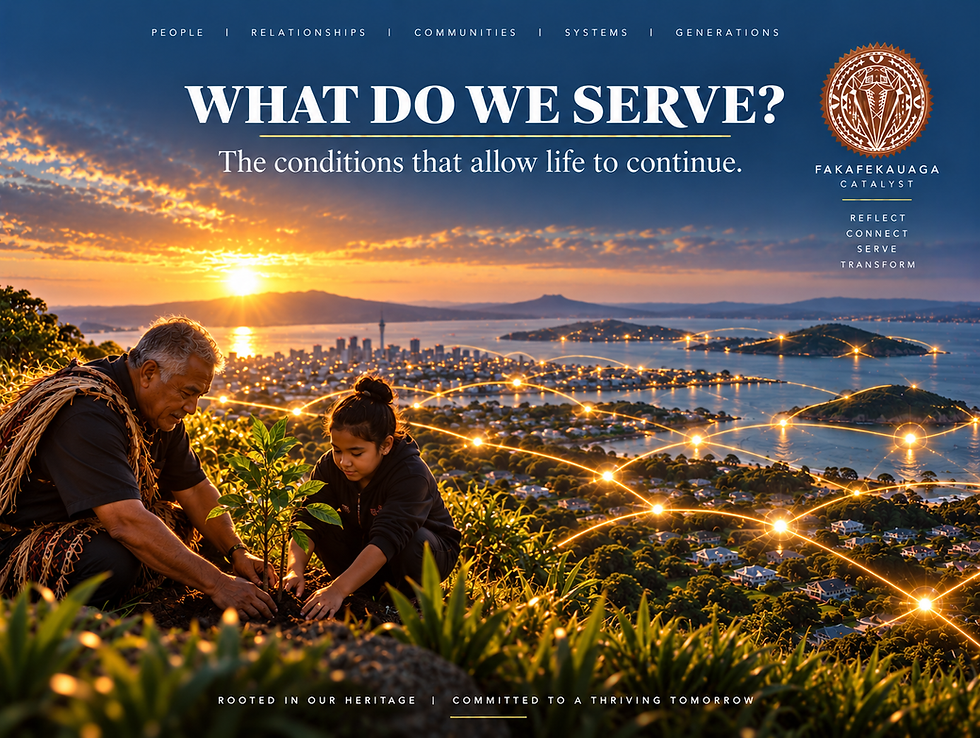
what do we serve
when do we serve
and why we serve?
Where leadership seeks transformation through disruption, Fakafekauaga evolves through seasonality, continuity, and stewardship.
Fakafekauaga is not a leadership framework, nor a cultural adaptation of Western systems thinking. It is an epistemological and ontological orientation that precedes leadership itself.
When viewed through a systems lens, Fakafekauaga functions as a form of collective and distributed governance. Authority is situational and relational rather than positional. Responsibility is collective and intergenerational rather than delegated upward. Action and collective wisdom emerge from shared understanding rather than directive power.
Far from being informal or naïve, such relational systems have governed village societies for centuries without concentrating existential risk in single individuals. They have done so not in the absence of conflict or scarcity, but through continuous relational accountability that prevents rupture from becoming collapse. This is not theory for us. It is lived knowledge.
Unnerving power without replacing it
As we consider Mintzberg’s examples, whether women throwing eggs at a corrupt senator, citizens bypassing propaganda through relational networks, or the proposal of an association of smaller democracies, we do not read these as calls for new leaders. We read them as illustrations of systemic pressure applied through collective agency.
What gives these examples their power is not symbolism, but logic. They operate laterally rather than vertically. They bypass formal authority and activate social, cultural, and moral feedback loops that power struggles to suppress.
Fakafekauaga operates in this same register. It does not seek to overthrow leadership, but rather complements it by embedding relational and distributed practices that make leadership more effective and less reliant on hierarchical authority. When organisations surface these questions, power, accountability, resource allocation, and care become tangible and negotiable. They move from abstract concepts to practical decisions. Power is engaged relationally, in ways that reinforce collective agency and sustain the stabilising role of responsible leadership.
Development shifts accordingly. Leaders grow not by accumulating authority, but by learning how to steward complexity. Teams mature through shared responsibility rather than individual heroics. Strategy becomes less about control and more about contribution within living systems.
Evolution, not revolution
Crucially, Fakafekauaga does not demand a sudden rupture from existing systems. That expectation itself reflects a leadership fantasy, the belief that salvation arrives through dramatic transformation. Fakafekauaga aligns instead with how living systems actually change, gradually, contextually, and through repeated acts of care, correction, and reciprocity.
This is evolution rather than disruption. Seasonality rather than shock. Continuity rather than conquest.
In a world fixated on bold leaders and decisive moments, this approach may appear insufficient. Yet history suggests otherwise. The most durable social systems are those that embed responsibility widely, privilege relationship over authority, and orient action toward long-term stewardship rather than short-term victory. This form of evolution is demanding, not passive, and it actively supports the work of leadership rather than negating it.
Toward survival beyond leadership
If Mintzberg is right that leadership as it is currently conceived is incapable of guiding us through the crises we face, then the task before us is not to refine leadership further, but to outgrow it.
For us, Fakafekauaga offers a glimpse of what comes next. Not a technique. Not a model. But a shift in how humans organise themselves within complex systems. It reminds us that survival does not depend on stronger leaders, but on stronger relationships. Not on better decisions at the top, but on wiser patterns throughout the whole.
At FFC, this is the work we support: partnering with organisations prepared to move beyond leadership as performance and redesign themselves around service, stewardship, and long-term wellbeing.
To survive the twenty first century, we may need to listen less to the bluster of leadership and more to the quiet intelligence of collective living systems, systems that Fakafekauaga has been cultivating all along.
Fakaotiaga - Conclusion
As we step into this new season of Fakafekauaga Catalyst, we are reminded that the work of collective stewardship is ongoing. Fakafekauaga asks us not only to reflect, but to act — to cultivate relationships, to nurture our communities, and to orient every choice toward the flourishing of the whole across generations. In a world often obsessed with individual leadership and rapid disruption, it calls us to slow down, listen deeply, and participate fully in the intelligence that emerges from living systems themselves. We offer this reflection not as a blueprint, but as an invitation: to experience Fakafekauaga in practice, to carry its lessons into your families, communities, and workplaces, and to join us in co-creating a world where responsibility, care, and connection guide our shared future.
This reflection marks the opening of a new series exploring Fakafekauaga as a living systems paradigm, moving from a critique of leadership toward applied servantship, collective stewardship, and intergenerational responsibility.
Our gratitude and acknowledgment - Fakaue lahi mahaki
In our Niuean oral culture, knowledge acquisition is deeply rooted in the tradition of observing our elders engaging with one another and our environment, gathering around our matua (parents) and tupuna (elders/grandparents) and attentively listening to their stories. Through this immersive experience, we each embark on a personal journey of sense-making, extracting valuable insights from these dialogues, known as talanoa.
In a departure from the rigid conventions of Western academic writing, where referencing and quoting are paramount, we intentionally embrace a more fluid approach, returning to our oral and cultural traditions. While acknowledging the great influence of specific elders or individuals who have shaped our thinking, we invite you to embark on your version of talanoa by engaging with the written works left behind by these wise sages. In simple terms, read them yourselves or seek out their audience to listen and derive your own meaning. By doing so, as we have done, you can forge a connection with their wisdom, assimilate knowledge and craft your own unique interpretations. We believe this process will empower you to cultivate a deep understanding, encapsulating the essence of talanoa while fostering an appreciation for the diverse perspectives available to us in our villages, communities, cities and worldwide. And so, we offer heartfelt gratitude and deep appreciation in humble tribute to the revered elders and invaluable individuals below who have influenced our emotional and intellectual landscape, instilling wisdom and guiding our pens to express our thoughts and interpretations of their multi-layered insights:
First and foremost – all of our magafaoa (families) and elders (matua/tupuna).
Secondly – to all elders and people whose knowledge and experiences we have referenced throughout this reflection – fakaue lahi mahaki. Henry Mintzberg is one such elder whose work on leadership and management has informed this discussion. We invite readers to explore Mintzberg's work for themselves to interpret and derive their own understanding from it.
FakaFekauaga Catalyst™ (FFC) – All rights reserved.
All content on this website is the intellectual property of FakaFekauaga Catalyst (FFC) and may not be copied, reproduced, or distributed without permission.


Comments