

Who Do We Serve

Updated: 5 days ago
By Falalahemotu Makapatama and Makapatama (George) Founders and Leveki – Guardians and Stewards of Fakafekauaga-Servantship, FakaFekauaga Catalyst (FFC) www.fakafekauagacatalyst.com
Kupu Matutakiaga – Opening insight / reflection
Organisations commonly define who they serve: customers, shareholders, funders, or communities. However, Fakafekauaga invites us to adopt a broader perspective. True service is never abstract; it is always relational, intergenerational, and ecological. In Fakafekauaga, knowing who we serve cannot occur from organisational distance alone. It emerges through sustained relationships with people, communities, and the places where organisational decisions are lived and experienced. Without this relational grounding, claims of service risk becoming rhetorical rather than accountable, and the long-term sustainability of decisions becomes uncertain. Service manifests not only in who benefits but also in who bears burdens, who is rendered invisible, and how natural and social systems are impacted by organisational choices.
This framing aligns with systems scholarship, which understands organisations as embedded within living social and ecological systems rather than operating apart from them (Senge, 1990; Folke et al., 2016). From this perspective, service cannot be reduced to transactional relationships with human stakeholders alone. It must also account for the ecological foundations that make social and economic life possible. Fakafekauaga Thinking approaches this as a form of system weaving. Systems evolve through the relationships that connect people, institutions, and place. Understanding who we serve therefore requires remaining in relationship with those who live with the consequences of decisions. Without these relationships, efforts to change systems risk becoming technical interventions rather than genuine social and ecological transformation.
Fakafekauaga, therefore, reframes service as a dual responsibility to people and to the planet. It recognises that human wellbeing is inseparable from the health of the natural systems we inhabit. This mirrors contemporary sustainability and resilience literature, which demonstrates that social justice, economic viability, and ecological integrity are structurally interdependent rather than competing domains (Raworth, 2017; Rockström et al., 2009).
The focus shifts from organisational ego to collective accountability. This shift reveals the tangible consequences of decisions across people, place, and time. In this view, service is not measured only by declared intent or organisational performance but by the distribution of impacts across communities, future generations, and the ecosystems that sustain them.
Where organisations claim to serve people, communities, or place without sustaining relationships with them, service risks becoming symbolic rather than lived. Fakafekauaga therefore treats relationship not as engagement activity but as the foundation of accountable service and stewardship.

A Fakafekauaga Reflection — Tutala 2 of the Servantship Series
This article builds on insights from How Do We Serve? (Tutala 1), continuing the exploration of Fakafekauaga-servantship as a living philosophy for leadership, relational accountability, and intergenerational responsibility.
Recentring accountability beyond the oganisation
In most organisations, the question of who is served is treated as settled. It is embedded in mission statements, funding arrangements, governance structures, and performance metrics. Service is commonly defined through formal organisational categories, creating a sense of clarity and closure around the question.
Yet this apparent clarity often masks a deeper ambiguity. When service is defined primarily by organisational classifications, attention shifts toward who is formally recognised rather than who is substantively affected. Fakafekauaga challenges this settlement by shifting the frame from declared beneficiaries to distributed consequences. It asks not only who is named but who is impacted, who bears cost, and whose futures are shaped by organisational decisions.
These realities are rarely visible through reports or metrics alone. They become visible through relationships with communities and with place, where the lived experience of organisational decisions can be heard, witnessed, and understood.
Within this framing, familiar answers still appear:
We serve customers.
We serve shareholders.
We serve members.
We serve funders.
We serve communities.
These categories are not incorrect; however, they are incomplete. They describe organisational relationships, but they do not fully capture the relational, intergenerational, and ecological consequences of organisational action. As a result, service can become oriented toward maintaining institutional legitimacy and performance logics rather than toward the lived wellbeing of people, communities, and ecosystems.
Fakafekauaga, therefore, introduces a more demanding question:
Who do we truly serve, not just in what we say, but in what people and communities actually experience?
This reframing moves service from a statement of purpose to a matter of accountability. It requires leaders to examine how benefits and burdens are distributed, whose voices shape decisions, and how organisational choices ripple across people, place, and time. In doing so, service is no longer treated as a settled category but as an ongoing ethical, relational, and ecological responsibility.
Beyond stakeholders: Expanding the circle of service
Traditional leadership frameworks often reduce service to stakeholder maps, which are useful but incomplete. Fakafekauaga widens the circle and slows the conversation, asking organisations to consider:
Whose voices shape our decisions, and whose are absent?
Who absorbs the risk when things go wrong?
Who carries the emotional, cultural, or relational labour of our success?
Who benefits immediately, and who pays over time?
Which parts of the natural world are affected, and how are ecological burdens distributed?
This expansion reflects what governance and sustainability scholars describe as a shift from narrow stakeholder models toward social-ecological systems thinking. Here, human and environmental wellbeing are treated as interdependent rather than separate policy domains (Folke et al., 2016; Ostrom, 2009).
Rather than asking only who has formal standing, Fakafekauaga asks who is affected in practice. These realities are rarely visible through reports or metrics alone. They become visible through relationships with communities and with place, where the lived experience of organisational decisions can be heard, witnessed, and understood. This includes those without voice, power, or visibility, as well as ecosystems that cannot represent themselves. This aligns with the growing recognition in environmental governance that non-human systems must be treated as legitimate bearers of consequence, even when they are not formal stakeholders (Rockström et al., 2009; Raworth, 2017).
This expansion includes:
People directly affected by decisions, even if outside formal structures.
Families and communities connected to the work.
Place, including land, environment, and local context.
Future generations who will inherit today’s outcomes.
Ecosystems and natural resources that underpin community wellbeing.
From this perspective, service is not only upward or outward but also intergenerational, ecological, and relational.
Who is centred when we say “We Serve”?
Fakafekauaga gently but firmly recentres the conversation away from organisational ego. It asks:
Are decisions made to preserve comfort or uphold responsibility?
Are trade-offs acknowledged or obscured?
Are people treated as resources or as relations?
Are natural systems treated as instruments or as partners in relational stewardship?
Where leadership frameworks ask who decides, Fakafekauaga asks who carries the consequences.
“Accountability begins to flow outward and forward to people, communities, and the ecosystems that sustain us rather than upward alone.”
This subtle but powerful shift transforms governance, strategy, and culture not through slogans but through sustained relational and ecological accountability (Senge, 1990; Raworth, 2017; Edmondson, 2018).
Serving the collective
In an era where purpose statements and values are increasingly performative, Fakafekauaga offers a quieter test: service is not what is declared but what is experienced by others and the world around us. Reflection through fono, which are gatherings where people come together as equals, surfaces experiential and relational knowledge that formal metrics cannot capture. These spaces are not simply consultation processes. They are relational practices that reconnect organisations with the people, communities, and places that carry the consequences of decisions.
Patterns emerge, harm can be named, and care can be restored (Heifetz et al., 2009). Through this process, organisations can see whether their service is:
Concentrated or shared.
Transactional or reciprocal.
Short-term or intergenerational.
Human-focused or inclusive of planetary wellbeing.
Evolving beyound leadership
Leaders who espouse the importance of supporting communities, stakeholders, or the environment but lack sustained connections risk leading from distance. Their decisions may prioritise business or organisational metrics over lived realities, and sustainability outcomes become uncertain.
Answering Who do we serve honestly often requires leaders to relinquish certainty. It may reveal that:
Systems reward the wrong outcomes.
Accountability flows in the wrong direction.
Success has been narrowly defined.
Ecological impacts have been overlooked.
From a Fakafekauaga perspective, this is not failure; it is maturation. Leadership evolves into Fakafekauaga-servantship when service is no longer centred on individual authority but on collective wellbeing and continuity (Heifetz, 1994; Uhl-Bien et al., 2007).
For leaders and managers, relational accountability also changes the experience of leadership itself. When leaders remain in genuine relationship with the people, communities, and places they serve, decision-making becomes more grounded in lived reality. Leaders gain deeper understanding, greater confidence in their judgement, and stronger relational trust. Service is no longer performed from organisational distance but practiced through shared responsibility with those who live with the consequences of decisions.
Stewardship emerges naturally within this practice:
As an outcome of Matutakiaga, where interconnectedness reminds us that humans are not separate from nature. Each action ripples across people, place, and future generations (Berkes, 2009).
As a role within the Leveki, where guardianship is actively enacted through decision-making, care, and relational accountability.
As a practice flowing from Fakafekauaga, expressed in ongoing care for others, for the environment, and for the legacies we leave behind.
Leadership, therefore, is not only what a person does; it is how they embody Mahuiga—the values, relationships, and responsibilities defined by Fakafekauaga. Stewardship is inseparable from its collective, relational, intergenerational, and ecological ethic.
Reflection towards stewardship practice
What this changes about growth
Growth becomes conditional on who benefits. Expansion that concentrates advantage or displaces burden is no longer legitimate growth. True growth is shared, distributed, and reparative. This reflects contemporary critiques of growth models that externalise social and ecological costs, calling instead for development frameworks that remain within social and planetary boundaries (Raworth, 2017; Rockström et al., 2009).
What this changes about strategy
Strategy must now map consequences, not just stakeholders. Planning processes must explicitly identify:
Who benefits.
Who bears risk.
Who is rendered invisible.
Who inherits long-term harm or gain.
This aligns with systems and complexity scholarship, which demonstrates that long-term organisational viability depends on recognising delayed effects, cross-system feedback, and cumulative impacts rather than optimising for short-term performance alone (Senge, 1990; Folke et al., 2016).
What this changes about vision
Vision is no longer inward-facing—our success. It becomes outward and forward-facing—our responsibility to others. The organisation’s imagined future must now include those who currently sit at the margins, as well as the ecological conditions that make any future prosperity possible. This reflects emerging governance thinking that treats intergenerational and ecological responsibility as central to legitimacy, not peripheral to it (Ostrom, 2009; Raworth, 2017).
Is this a capability you are actively developing?
Many organisations will recognise the ethical coherence in Fakafekauaga-servantship. Yet recognition is not the same as capability. Fakafekauaga functions as a diagnostic lens, exposing the gap between stated service commitments and the actual consequences of decisions (Heifetz et al., 2009).
Questions leaders may ask themselves include:
Under conditions of urgency or political pressure, what decision-making logics dominate: performance optimisation or relational stewardship?
To what extent are care, reciprocity, intergenerational accountability, and ecological responsibility explicitly embedded in governance processes, incentives, and routines?
When trade-offs are unavoidable, whose strain is visible in deliberation, whose is systematically externalised, and what environmental burdens are created or ignored?
These are structural and systemic questions, not questions of personal character. Leadership systems must be intentionally architected to sustain Fakafekauaga-servantship in practice (Heifetz, 1994; Uhl-Bien et al., 2007; Edmondson, 2018).
Insight to evolving developmental practice
From a Fakafekauaga perspective, the work of knowing who we serve cannot be delegated to personal virtue alone. It must be embedded into formal and informal organisational practices.
Practical steps may include:
Mapping consequences beyond stakeholders alone. Identify who benefits, who bears risk, who inherits long-term impact, and which ecosystems are affected (Berkes, 2009; Raworth, 2017).
Embedding relational and ecological accountability into governance processes, strategy, and routines (Edmondson, 2018; Senge, 1990).
Institutionalising Fakafekauaga as a repeatable servantship practice rather than a symbolic narrative.
Through this approach, organisations shift from reflection into active developmental practice. They grow not by scale alone but by becoming better ancestors, accountable to the full circle of people, place, and planet over time.
One practical way organisations can begin living this question is through what we call the Consequence Map. This reflective governance practice is grounded in Fakafekauaga and invites leaders and teams to examine not only who they intend to serve, but who actually experiences the outcomes of organisational decisions across people, place and time.
Practice for leaders and organisations
Creating a 'Consequence Map'
For major initiatives, convene a fono-style session to ask:
Who benefits immediately?
Who carries the cost later?
Whose voices were not in the room?
Who will live with the outcome long after we are gone?
Which ecosystems and natural resources are impacted, and how will these consequences be managed?
This practice is not only analytical, but also relational. By bringing leaders into direct conversation with those affected by decisions, organisations begin to restore the relational accountability necessary for genuine stewardship.
Let's reflect
This article does not offer a single correct answer. Fakafekauaga resists that by design. Instead, it invites organisations, teams, and communities to reflect together. From a Fakafekauaga perspective, the question of who we serve can never be answered once and for all. It must be continually rediscovered through relationships with people, communities, and the places where organisational decisions are lived and experienced. These relationships ensure that accountability extends not only to present stakeholders but also to future generations and the ecological systems that sustain life. Without sustained connection, claims of service risk being rhetorical rather than actionable, and the long-term sustainability of decisions becomes uncertain.
Who has truly been served by our work so far, including people and the planet?
Who has not?
Who should be more visible in our decision-making?
Who are we accountable to beyond ourselves, beyond current generations, and beyond human communities?
These are questions to be lived with, returned to, and held collectively. In doing so, organisations begin to shift not by adopting a new framework but by entering a new relationship with relational and ecological responsibility (Berkes, 2009; Raworth, 2017; Ostrom, 1990).
We do not serve isolated categories of people or separated systems of need. We serve within a living field of relationships that includes people, land, ancestors and those yet to come. Service is therefore never contained in a single direction. It is always part of a wider obligation to maintain the continuity of the village across time.
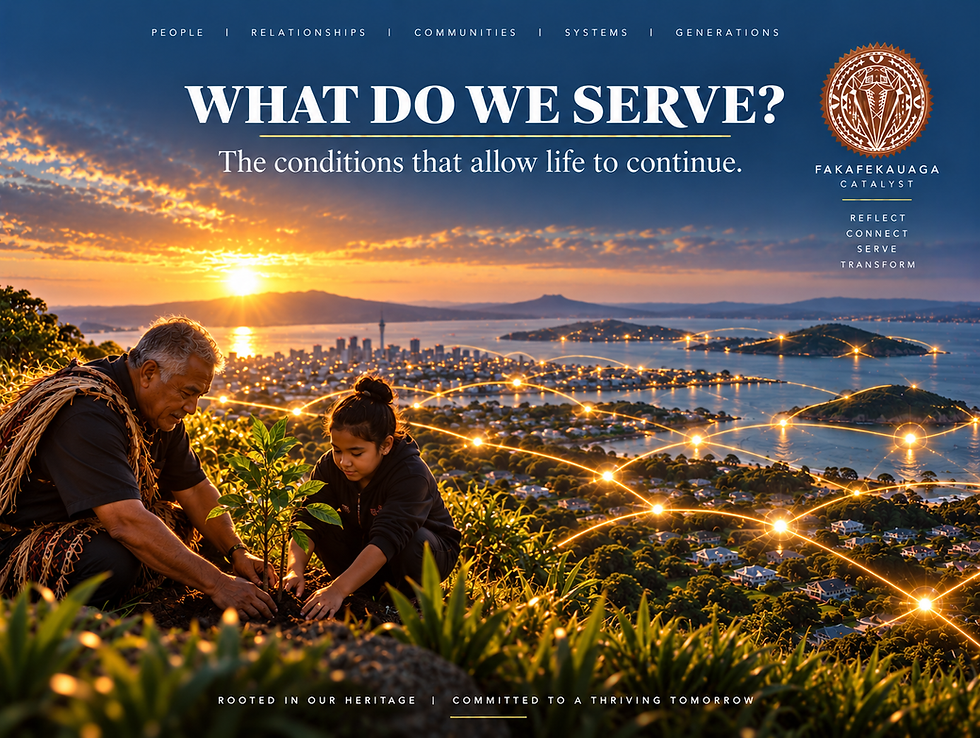
Next in the Series: What Do We Serve?
This article is part of The Fakafekauaga Servantship Series—exploring Fakafekauaga as a living systems paradigm for servantship, collective stewardship, and intergenerational responsibility.
Reference
Our gratitude and acknowledgment — Fakaue lahi mahaki
In our Niuean oral culture, knowledge acquisition is deeply rooted in the tradition of observing our elders engaging with one another and our environment. We gather around our matua (parents) and tupuna (elders/grandparents) and attentively listen to their stories. Through this immersive experience, we each embark on a personal journey of sense-making, extracting valuable insights from these dialogues, known as talanoa.
In a departure from the rigid conventions of Western academic writing, where referencing and quoting are paramount, we intentionally embrace a more fluid approach, returning to our oral and cultural traditions. While acknowledging the influence of specific elders and scholarly works that have shaped our thinking, we invite you to explore the original sources and form your own interpretations through your own talanoa.
We offer heartfelt gratitude to the following individuals and foundational works that have informed the ideas in this article:
First and foremost — all of our magafaoa (families) and elders (matua / tupuna).
Secondly — to all elders and people whose knowledge and experiences we have drawn upon throughout this reflection — fakaue lahi mahaki.
Among these sources are:
Carl Folke and colleagues, whose article Social‑ecological resilience and biosphere‑based sustainability science explores the intertwined nature of social and ecological systems and the need to treat them as co‑evolving, adaptive systems rather than separate domains, providing the foundation for understanding organisations within living biospheres.
Johan Rockström and co‑authors, whose paper Planetary Boundaries: Exploring the Safe Operating Space for Humanity identifies a set of Earth system limits within which humanity can safely operate, grounding ecological integrity as an essential dimension of organisational and societal wellbeing.
Elinor Ostrom, whose work A general framework for analyzing sustainability of social‑ecological systems offers a conceptual framework for understanding how social and ecological systems interact and co‑governed commons can be sustained, informing our view of interdependence across human and non‑human systems.
Mary Uhl‑Bien, Russ Marion, and Bill McKelvey, whose article Complexity Leadership Theory: Shifting Leadership from the Industrial Age to the Knowledge Era develops a framework for leadership that embraces complexity, adaptation, and relational dynamics rather than top‑down control, enriching our understanding of relational accountability in leadership practice.
Ronald Heifetz, whose scholarship on adaptive leadership, including Leadership Without Easy Answers and The Practice of Adaptive Leadership, helps distinguish between technical problem‑solving and the deeper work of shifting values, relationships, and responsibilities in collective life.
Amy Edmondson, whose research on psychological safety and learning organisations, particularly The Fearless Organization, provides insight into how trust, dignity, and mutual accountability shape an organisation’s capacity to learn, adapt, and respond to complexity.
Peter Senge, whose articulation of systems thinking in The Fifth Discipline underpins our understanding of organisations as living systems embedded within larger environmental and social contexts.
Kate Raworth, whose concept of Doughnut Economics reframes growth and economic success within social and planetary boundaries, supporting the article’s emphasis on interdependence between human wellbeing and ecological limits.
As with all wisdom traditions, these insights are not to be consumed as doctrine but engaged as conversation. We invite readers to read, reflect, and integrate your own lived knowledge in dialogue with these works and thinkers. Through this process, may each of us deepen our understanding of service, stewardship, and our shared responsibility to one another, future generations, and the ecosystems that sustain life.
Series Foundations
Falalahemotu, F. & Makapatama, G. (2026). Fakafekauaga – A New Paradigm of Service.* The Fakafekauaga Servantship Series. FakaFekauaga Catalyst (FFC).
Falalahemotu, F. & Makapatama, G. (2026). How Do We Serve?The Fakafekauaga Servantship Series — Tutala 1.* FakaFekauaga Catalyst (FFC).
Falalahemotu, F. & Makapatama, G. (2026). Who Do We Serve? The Fakafekauaga Servantship Series — Tutala 2. FakaFekauaga Catalyst (FFC).
FakaFekauaga Catalyst™ (FFC) – All rights reserved.
All content on this website is the intellectual property of FakaFekauaga Catalyst (FFC) and may not be copied, reproduced, or distributed without permission.


Comments