

What Do We Serve

Updated: 3 days ago
By Falalahemotu Makapatama and Makapatama (George) Founders and Leveki – Guardians and Stewards of Fakafekauaga-Servantship, FakaFekauaga Catalyst (FFC) www.fakafekauagacatalyst.com
Kupu Matutakiaga – Opening Insight / Reflection
Many organisations define service in familiar ways. They often equate service with outputs—products, projects, KPIs, or targets—and overlook the deeper responsibilities their work carries. Fakafekauaga reframes service not as what we produce, but as what we preserve, strengthen, and carry forward across people, communities, ecosystems, and generations.
Building on reflections from Tutala 1 (how we serve) and Tutala 2 (who benefits and bears consequences), this article asks a deeper question: what are we truly sustaining? It shifts focus from immediate outputs to the enduring impact of our work on relationships, social and ecological systems, and the generations that follow. For leaders, this perspective transforms strategy, governance, and everyday decisions into instruments of long-term collective well-being.
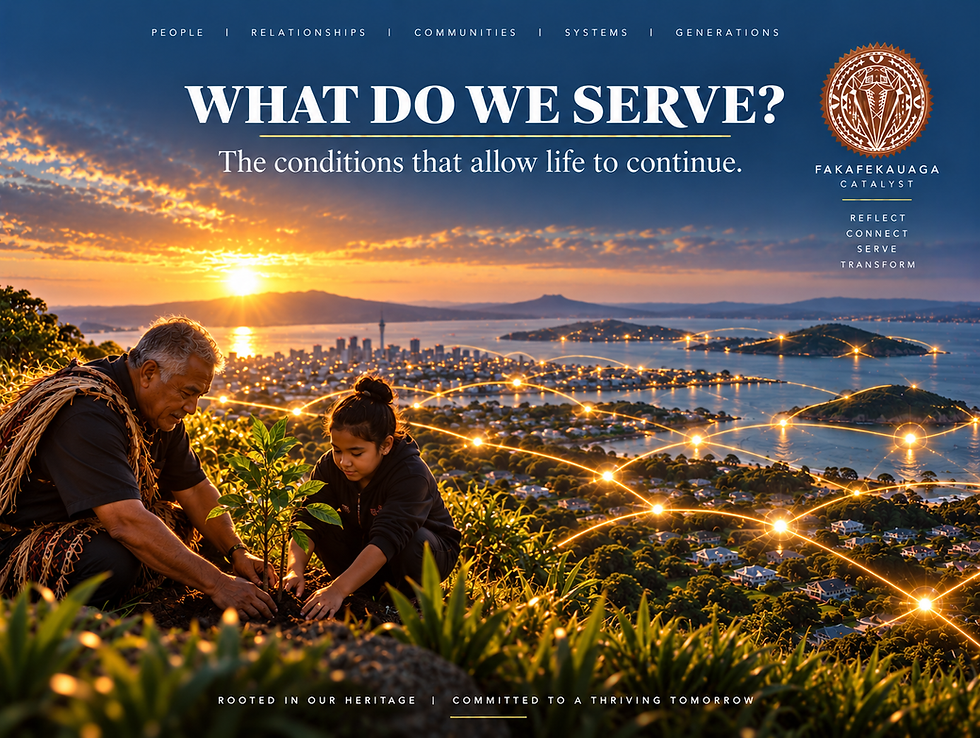
A Fakafekauaga Reflection — Tutala 3 of the Servantship Series
What Do We Serve?
Most organisations assume they know the answer: products, services, profit, growth, targets, reports. Fakafekauaga challenges this assumption by asking a deeper question:
“What is the true substance of our service?
Service extends beyond what we produce. Deliverables conclude, projects finish and reports close. Fakafekauaga reframes service as relational, cumulative, and enduring, measured not only by outputs, but by strengthened relationships, resilience built, and collective well-being (Heifetz, 1994; Ostrom, 1990; Senge, 1990; Folke et al., 2016).
This perspective builds on the Consequence Map introduced in Tutala 2, which helps leaders explore who benefits, who bears burdens, and how ecosystems are affected. While the Consequence Map focuses on who is impacted, “What Do We Serve?” shifts attention to what is sustained, connecting the circle of responsibility to the circle of legacy.
To understand what we truly serve, organisations must reflect collectively and courageously ask themselves:
What is the deeper impact of our work on people, communities, and the environment?
Are we sustaining connections, resources, or knowledge for future generations?
Do our actions restore balance or merely redistribute burden?
Where does our service stop, and where could it extend further?
These questions move organisations beyond transactional thinking toward relational stewardship. Leaders are invited to examine the long-term, intergenerational consequences of their decisions, aligning strategy, operations, and leadership practice with enduring social and ecological outcomes (Berkes, 2009; Raworth, 2017; Rockström et al., 2009).
Tangible vs. Intangible service
Fakafekauaga invites organisations to recognise both tangible and intangible dimensions of service. Traditional leadership and performance frameworks often emphasise outputs; products, reports, revenue, or KPIs (Kaplan & Norton, 1996). These are necessary but insufficient. True service extends beyond deliverables to the enduring relationships, trust, and cultural continuity that underpin organisational and community well-being (Berkes, Folke & Colding, 2003; Schultz & Hatch, 1996).
Tangible outcomes include visible outputs, projects, structures, and measurable deliverables.
Intangible outcomes include nurtured relationships, cultivated trust, transmitted knowledge, and preserved legacies.
Focusing solely on tangible results risks serving numbers rather than people or systems. When outputs become the end goal, organisations may inadvertently prioritise efficiency or optics over long-term relational and ecological stewardship (Friedman & Miles, 2006).
Fakafekauaga emphasises that service is relational, cumulative, and enduring, and cannot be fully captured by conventional metrics alone. By integrating both tangible and intangible outcomes into governance, strategy, and evaluation, organisations can assess not just what is produced but what is sustained. Leadership becomes accountable for preserving and strengthening human, social, and ecological capital, ensuring actions today contribute to collective resilience, intergenerational well-being, and relational integrity (Berkes et al., 2003; Edmondson, 2018).
While the Consequence Map in Tutala 2 helps organisations see who benefits and who bears burdens, assessing tangible and intangible service allows leaders to evaluate what endures beyond immediate outcomes: the relationships, knowledge, and ecosystems that give meaning to those consequences.
“True service is felt in continuity, seen in strengthened relationships, and verified in collective well-being, not only in metrics we can count.”
The lens of intergenerational responsibility
Fakafekauaga situates service within a Tupuna-to-Mokopuna (ancestor-to-descendant) temporal ethic, emphasising that today’s choices ripple far beyond immediate outcomes (Falalahemotu & Makapatama, 2026). Leadership from this perspective is less about authority over the present and more about care for those who inherit the future.
This approach aligns with research on long-horizon governance and ethical leadership. Raworth’s (2017) Doughnut Economics framework highlights that organisational success must be measured not only against current performance metrics but also against social and ecological boundaries that safeguard future generations. Similarly, Rockström et al. (2009) emphasise that human activity must operate within planetary limits to maintain stable Earth systems.
Applying this lens reframes success as prioritising legacy over immediate reward, stewardship over authority, and systems thinking in action. Impact is measured not by short-term gains but by continuity, resilience, and flourishing across generations. Leadership is exercised through care, foresight, and relational accountability, rather than command. Decisions must account for communities, ecosystems, and knowledge systems that endure beyond the present.
Building on Tutala 2, where the Consequence Map expanded leadership accountability outward and forward, the intergenerational lens extends responsibility across time, ensuring decisions today sustain the capacity of communities, ecosystems, and knowledge systems for generations to come.
Organisations adopting this perspective ask:
Do current initiatives enhance the capacity of communities, ecosystems, and knowledge systems to endure?
Do policies and strategies preserve, repair, or strengthen relational, social, and environmental capital?
Are long-term consequences explicitly assessed alongside short-term objectives?
By adopting the Tupuna-to-Mokopuna lens, service becomes a measure of intergenerational stewardship, complementing conventional performance measures (Ostrom, 1990; Berkes et al., 2003; Folke et al., 2016).
Key insight for leaders: decisions are most effective when they anticipate and embed consequences for future generations, transforming service from a transactional act into a practice of enduring stewardship.
Aligning actions with Core Human Characteristics
In Tutala 2, we examined who carries the consequences of our service. Here, we explore what human capacities enable service to endure, linking ethical accountability to the practical cultivation of relational and intergenerational stewardship.
Within Fakafekauaga, asking “What do we serve?” is inseparable from understanding the human capacities and values that shape action. Service is enacted not only through outputs or processes but through the embodiment of five core characteristics:
Matutakiaga – Interconnectedness, relational, thinking as a system and systems evolution
Decisions and actions must reflect the interdependence of systems, communities, and relationships, rather than treating initiatives as isolated projects. Recognising interconnectedness ensures leaders account for cascading social, economic, and ecological impacts, linking today’s actions to future generations.
Mahuiga – Values-based living, ancestral knowledge, lived experience
Leaders serve with integrity, humility, and commitment to the collective good. Mahuiga strengthens trust, organisational commitment, and resilience, ensuring decisions align with stated values even under complexity and pressure.
Fakalofa – Love, compassion and emphathy
Service is enacted with empathy and care, placing the needs of others alongside organisational goals. Fakalofa cultivates dignity, respect, psychological safety, and inclusivity, extending consideration even to non-human systems that sustain life for future generations.
Fakamokoi – Reciprocity – give and forget but receive and remember always
Service is framed through giving, restoring, and recognising mutual obligations. Embedding Fakamokoi ensures accountability is relational, restorative, and sustainable, reinforcing fairness across present and future communities.
Matohiaga – Genealogy – contextualised - past, present and future.
Leaders act with foresight, considering how present decisions affect future generations. Matohiaga operationalises the Tupuna-to-Mokopuna lens, guiding planning, consequence mapping, and the Legacy Test, making intergenerational responsibility a core organisational practice.
When leaders integrate these characteristics, service transforms from transactional or episodic behaviour into a disciplined, relational, and cumulative practice. Outputs alone no longer define success; instead, organisations cultivate trust, resilience, and continuity across systems, communities, and generations.
Key insight for leaders: embodying these capacities ensures decisions not only achieve operational goals but also sustain relationships, ecosystems, and intergenerational well-being. Service becomes a practice embedded in daily decision-making, not an abstract ideal.
Reflection to stewardship practice
Just as the Consequence Map in Tutala 2 visualised who is affected, and the Legacy Test examines long-term impacts, embedding these tools into growth, strategy, and vision ensures organisational success is measured not just by outputs, but by the endurance of relationships, social cohesion, ecological integrity, and intergenerational well-being.
Fakafekauaga situates leadership not merely as a set of actions, but as a system for sustaining life, relationships, and ecosystems over time. Moving from reflection to practice requires translating the five core human characteristics into organisational structures, processes, and routines. This ensures that service is embedded in operational DNA, not dependent solely on individual virtue.
Growth: Measured by continuity, not just output
Traditional metrics focus on scale, profit, and KPIs. Fakafekauaga reframes growth as relational and regenerative:
Relational growth: Are trust, collaboration, and social cohesion deepening across teams and communities?
Ecological growth: Are natural resources maintained or restored, rather than depleted?
Generational growth: Are today’s practices leaving systems stronger for future generations?
Growth is now explicitly assessed through the five core characteristics—Matutakiaga, Mahuiga, Fakalofa, Fakamokoi, and Matohiaga—ensuring that organisational expansion aligns with systemic well-being, not just outputs (Fuller & Lochard, 2020).
Strategy: From transactional plans to relational design
Strategy shifts from optimising outputs to stewarding relationships, resources, and systems:
Identify who benefits, who bears costs, and how burdens are distributed.
Map tangible and intangible assets: infrastructure, knowledge, trust, and cultural practices.
Prioritise long-horizon thinking, accounting for intergenerational and ecological impacts.
Incorporating the Legacy Test ensures decision-making is anticipatory, systemic, and accountable, transforming strategy into an instrument of care as well as performance (Senge, 1990; Uhl-Bien et al., 2007).
Vision: From market position to legacy statement
Vision becomes a moral and relational compass, guiding organisations to ask:
What enduring outcomes will we leave in people, communities, and ecosystems?
How do today’s choices reflect the ancestors we aspire to be?
Does our future safeguard rights, well-being, and ecological foundations for generations yet to come?
By integrating the five core characteristics, vision embeds interconnectedness, values-driven action, compassion, reciprocity, and intergenerational responsibility at the heart of organisational purpose. It guides daily decisions as much as long-term strategy (Ostrom, 2009; Bansal & Song, 2017).
Embedding stewardship as organisational capability
Fakafekauaga frames stewardship as a capability that must be intentionally developed and institutionalised. Organisations embed this by:
Diagnosing current service practices – Examine how service is enacted beyond slogans or rhetoric.
Identifying latent extraction logics – Reveal hidden patterns in strategy, metrics, or governance that prioritise short-term gain over long-term stewardship.
Redesigning deliberative processes – Embed care, reciprocity, and intergenerational responsibility as explicit criteria in decision-making.
Institutionalising Fakafekauaga as repeatable practice – Ensure stewardship becomes part of the organisational DNA, not a symbolic narrative.
This approach aligns with adaptive leadership scholarship, which shows that values and ethical commitments endure only when supported by systems, not left to individual character (Heifetz et al., 2009; Uhl-Bien et al., 2007).
By embedding stewardship structurally, organisations grow not just in scale, but as better ancestors, accountable to people, communities, and ecosystems across time.
Let's reflect - What will you mokopuna say about you?
Reflection in Fakafekauaga is practical, disciplined, and action-oriented. It helps leaders identify gaps between intention and consequence, authority and accountability, outputs and long-term impact (Heifetz et al., 2009; Edmondson, 2018).
Reflection questions for leaders and teams:
Are our outputs sustaining life, relationships, and collective well-being, or merely fulfilling short-term targets?
Do our strategies build resilience and harmony, or prioritise convenience and efficiency?
Whose voices are present in decision-making, and whose are absent?
Are we serving the short-term comfort of the organisation, or the long-term flourishing of people, communities, and ecosystems?
How are ecological and social costs accounted for, and who bears these trade-offs?
From reflection to collective stewardship
Reflection is most effective when it informs action. Fakafekauaga treats it as a lever for learning and systemic adaptation:
It surfaces patterns of inequity, ecological stress, or relational imbalance.
It identifies gaps where care, reciprocity, or accountability are weak.
It guides the redesign of processes, incentives, and governance so stewardship becomes embedded rather than incidental.
Through continuous reflection, leadership shifts from transactional roles to relational, ethical, and intergenerational responsibility (Edmondson, 2018; Bansal & Song, 2017).
Measuring what matters
Traditional metrics often focus on outputs or efficiency. Fakafekauaga encourages measuring the impact of service itself:
Strengthened relational networks and trust across stakeholders (Senge, 1990; Berkes et al., 2003).
Increased ecological resilience or restoration (Folke et al., 2016).
Distribution of benefits and burdens over time, including future generations (Raworth, 2017).
Continuity of knowledge, culture, and practices passed forward.
By measuring what is sustained rather than only what is produced, organisations align operational success with the ethics and outcomes of true service.
The legacy test — Operationalising stewardship
The Legacy Test is a structured, relationally grounded practice that evaluates whether initiatives serve people, place, and future generations.
Guiding questions:
What will still be alive in my lifetime, in my children’s lifetime and in my grandchildren’s lifetime?
Consider relationships, knowledge, cultural practices, and ecosystems.
What might be diminished, extracted, depleted, or lost?
Identify unintended consequences, burdens shifted to vulnerable communities, or environmental degradation.
Who benefits, and who bears the cost?
Move beyond formal stakeholders to include families, communities, and ecosystems.
Would future generations thank us or question our choices?
Incorporate foresight to anticipate outcomes decades ahead.
Embedding the legacy test:
Fono-Style Dialogues: Collective discussions that surface multiple perspectives often overlooked in hierarchical decision-making (Heifetz et al., 2009).
Consequence Mapping: Visualising benefits, burdens, and ecological impacts across time and systems (Senge, 1990; Ostrom, 2009).
Integrated Governance: Incorporate into planning cycles, governance routines, and performance frameworks to make reflection systemic (Bansal & Song, 2017).
Iterative Feedback: Review past initiatives to strengthen relational stewardship (Edmondson, 2018).
From practice to organisational culture
When consistently applied, the Legacy Test cultivates Fakafekauaga and stewardship as a repeatable organisational capability:
Leaders habitually consider long-term, relational, and ecological consequences before acting.
Organisations move from transactional thinking to relational accountability, aligning strategy with collective well-being.
Reflection, decision-making, and accountability form a continuous cycle of service.
Service is no longer measured by outputs alone, but by what persists, flourishes, and strengthens across generations. Fakafekauaga transforms ethical commitments into concrete, repeatable practices, embedding intergenerational and ecological responsibility at the heart of organisational life.
What we serve is not a task or output, but the conditions that allow life to continue with integrity. This includes the wellbeing of people, the care of sea and land, and the preservation of relationships that hold communities across generations. In this sense, service is always directed toward continuity...toward ensuring that the village remains capable of sustaining itself into the future.
Next in the Series: When Do We Serve?
Tutala 4 will explore when service is most effective and ethical, inviting leaders to consider not just how, who, and what they serve, but the timing and conditions that make their service truly regenerative and relational.
This continues the progression of the Fakafekauaga Servantship Series:
Tutala 1: How we serve — understanding the essence of service beyond outputs.
Tutala 2: Who we serve — examining beneficiaries and those who bear consequences.
Tutala 3: What we sustain — focusing on relational, social, and ecological endurance.
Tutala 4 (upcoming): When we serve — exploring timing, conditions, and contexts that maximise intergenerational and ecological responsibility.
By adding the temporal dimension, leaders are equipped to align actions with opportune moments, environmental readiness, and systemic rhythms, ensuring that service is not only well-intentioned but optimally impactful.
Reference
Our gratitude and acknowledgment — Fakaue lahi mahaki
In our Niuean oral culture, knowledge acquisition is deeply rooted in the tradition of observing our elders engaging with one another and our environment, gathering around our matua (parents) and tupuna (elders/grandparents) and attentively listening to their stories.
Through this immersive experience, we each embark on a personal journey of sense‑making, extracting valuable insights from these dialogues, known as talanoa.
In a departure from the rigid conventions of Western academic writing, where referencing and quoting are paramount, we intentionally embrace a more fluid approach, returning to our oral and cultural traditions. While acknowledging the influence of specific elders and scholarly works that have shaped our thinking, we invite you to explore the original sources and form your own interpretations through your own talanoa.
We offer heartfelt gratitude to the following individuals and foundational works that have informed the ideas in this article:
First and foremost, all of our magafaoa (families) and elders (matua / tupuna).
Secondly, to all elders and people whose knowledge and experiences we have drawn upon throughout this reflection, fakaue lahi mahaki.
Among these are:
Carl Folke and colleagues, whose article Resilience thinking: Integrating resilience, adaptability and transformability explore the intertwined nature of social and ecological systems and the need to treat them as co‑evolving, adaptive systems rather than separate domains, providing the foundation for understanding organisations within living biospheres.
Johan Rockström and co-authors, whose paper Planetary boundaries: Exploring the safe operating space for humanity identifies a set of Earth system limits within which humanity can safely operate, grounding ecological integrity as an essential dimension of organisational and societal wellbeing.
Elinor Ostrom, whose work Governing the commons and framework for analyzing sustainability of social–ecological systems offer a conceptual foundation for understanding how social and ecological systems interact, informing our view of interdependence across human and non-human systems.
Mary Uhl‑Bien, Russ Marion, and Bill McKelvey, whose article Complexity Leadership Theory: Shifting Leadership from the Industrial Age to the Knowledge Era develops a framework for leadership that embraces complexity, adaptation, and relational dynamics rather than top-down control, enriching our understanding of relational accountability in leadership practice.
Ronald Heifetz, whose scholarship on adaptive leadership, including Leadership Without Easy Answers and The Practice of Adaptive Leadership, helps distinguish between technical problem-solving and the deeper work of shifting values, relationships, and responsibilities in collective life.
Amy Edmondson, whose research on psychological safety and learning organisations, particularly The Fearless Organization, provides insight into how trust, dignity, and mutual accountability shape an organisation’s capacity to learn, adapt, and respond to complexity.
Peter Senge, whose articulation of systems thinking in The Fifth Discipline underpins our understanding of organisations as living systems embedded within larger environmental and social contexts.
Kate Raworth, whose concept of Doughnut Economics reframes growth and economic success within social and planetary boundaries, supporting the article’s emphasis on interdependence between human wellbeing and ecological limits.
As with all wisdom traditions, these insights are not to be consumed as doctrine but engaged as conversation. We invite readers to read, reflect, and integrate your own lived knowledge in dialogue with these works and thinkers. Through this process, may each of us deepen our understanding of service, stewardship, and our shared responsibility to one another, future generations, and the ecosystems that sustain life.
Series Foundations
Falalahemotu, F. & Makapatama, G. (2026). Fakafekauaga – A New Paradigm of Service. The Fakafekauaga Servantship Series. FakaFekauaga Catalyst (FFC).
Falalahemotu, F. & Makapatama, G. (2026). How Do We Serve? The Fakafekauaga Servantship Series — Tutala 1. FakaFekauaga Catalyst (FFC).
Falalahemotu, F. & Makapatama, G. (2026). Who Do We Serve? The Fakafekauaga Servantship Series — Tutala 2. FakaFekauaga Catalyst (FFC).
Falalahemotu, F. & Makapatama, G. (2026). What Do We Serve? The Fakafekauaga Servantship Series — Tutala 3. FakaFekauaga Catalyst (FFC).
FakaFekauaga Catalyst™ (FFC) – All rights reserved.
All content on this website is the intellectual property of FakaFekauaga Catalyst (FFC) and may not be copied, reproduced, or distributed without permission.


Comments