

When Do We Serve

Updated: Sep 9
By Falalahemotu Makapatama and Makapatama (George) Founders and Leveki – Guardians and Stewards of Fakafekauaga-Servantship, FakaFekauaga Catalyst (FFC) www.fakafekauagacatalyst.com
Kupu Matutakiaga – Opening insight / Reflection
In the evolution of Fakafekauaga as a governance philosophy, service has been progressively understood through three interdependent questions: Who do we serve, How do we serve and What do we serve. Across the earlier Tutala in this series, these questions expanded the meaning of service beyond delivery, toward relational responsibility, practice integrity and intergenerational consequence.
Together, they establish service not as a functional activity, but as a form of entrusted relational responsibility carried across time, people and systems.
This article introduces a fourth governing question: When do we serve?
This question shifts attention from intent, purpose and delivery to the conditions under which service becomes appropriate, received and stabilising within the systems it enters. It reframes timing not as scheduling or efficiency, but as a dimension of governance that shapes whether action strengthens or distorts relational and system balance.
Within Fakafekauaga servantship, timing is therefore not neutral. It is part of relational responsibility itself. Service must be understood not only by what it does, or who it is for, but by when it occurs within the lived conditions of systems.
In this sense, “When we serve” extends servantship into a discipline of discernment: recognising that systems carry readiness, saturation and transition states that influence whether action restores balance or unintentionally compounds strain. This article explores that shift, from service as action to service as relational responsibility shaped by timing within living systems.

A Fakafekauaga Reflection — Tutala 4 of the Servantship Series
This article builds on insights from How Do We Serve? (Tutala 1), Who Do We Serve? (Tutala 2) and What Do We Serve? (Tutala 3), continuing the exploration of Fakafekauaga-servantship as a living philosophy for leadership, relational accountability, and intergenerational responsibility.
Evolving fron service delivery to temporal responsibility
Service is usually judged by what we do and why we do it. This article poses a different question: when do we serve?
Across public, private and community sectors, service is typically evaluated through intent, delivery, and measurable outcomes. Governance systems ask whether organisations are acting, whether programmes are implemented, and whether outputs are achieved within expected timeframes. Within this dominant frame, time is treated primarily as an administrative variable: funding cycles, reporting periods, project timelines, and policy rollouts.
These structures implicitly assume that time is neutral. They position action as inherently beneficial, provided that intent is clear and execution is effective.
Yet across sectors, a different pattern is emerging:
Communities experience consultation fatigue.
Workforces carry layers of overlapping initiatives.
Reforms accumulate without producing proportional improvement.
Interventions multiply while trust, capacity, and relational cohesion often decline.
In such environments, the central challenge is not always whether organisations are doing enough. It is whether they are acting at the right time, in the right way, for the systems they seek to serve.
This tension reflects a deeper shift in how complex systems are understood. Research across adaptive leadership and complexity scholarship shows that outcomes rarely result from interventions alone. They emerge from interaction patterns within systems whose readiness, capacity, and internal dynamics evolve over time. Institutional systems are designed to accelerate activity, demonstrate responsiveness, and maintain momentum. They reward visible action and often treat delay as risk. However, in living systems, poorly sequenced or premature action can become a source of cumulative pressure rather than progress.
The consequence is a paradox increasingly visible across sectors: organisations become more active while the systems around them become more strained.
This paradox is rarely interpreted as a timing problem. It is more often explained through language of capacity gaps, resistance to change, implementation failure, or resource constraints. Yet these explanations frequently describe symptoms rather than causes. Beneath them sits a less visible condition: misalignment between the timing of intervention and the lived state of the system.
Understanding this misalignment requires a shift from viewing time as a neutral backdrop for action toward recognising it as a condition that shapes how service is received, carried, and integrated. Systems carry histories, relationships, accumulated pressures, and emerging transitions. Interventions do not enter empty space. They enter environments already shaped by what has come before.
Timing misalignment often appears in three ways:
When action arrives before readiness forms, it can generate resistance.
When it arrives after capacity is depleted, it can compound strain.
When it arrives during transition, it can lock in unintended trajectories.
Seen in this way, timing becomes more than an operational consideration. It becomes a governing condition that shapes whether service stabilises systems or contributes to their fragmentation.
This reframing moves leadership beyond the question of whether to act toward a more demanding responsibility: discerning when action becomes appropriate within the evolving life of a system.
The next section explores what happens when this alignment is absent and why mistimed service often remains invisible within conventional governance systems.
The hidden cost of mistimed service
Leaders are rarely taught to think about timing as a systemic risk. Leadership development typically emphasises speed, responsiveness, and execution. Acting quickly is often associated with competence, while delay is easily interpreted as failure or indecision.
Fakafekauaga reframes this assumption. Change is not understood as the acceleration of activity, but as system-led evolution that emerges when relational and ecological conditions are ready to support it (Falalahemotu and Makapatama, 2024). This creates an enduring tension between institutional urgency and system readiness.
Institutional incentives reinforce this bias toward action. Funding cycles demand visible activity. Political environments reward responsiveness. Performance systems privilege outputs over long-term systemic consequences. Within this environment, inaction is often perceived as a significant risk. From a Fakafekauaga perspective, however, action without relational readiness or system capacity may represent a weakening of entrusted responsibility across time rather than strength of leadership.
Within complex systems, premature or poorly sequenced action can be more damaging than delay.
The consequences of this tension are rarely immediate. Mistimed service does not always appear as failure in the moment. It is often experienced instead as the gradual accumulation of strain: communities fatigued by repeated engagement processes, workforces overwhelmed by layers of uncoordinated initiatives, and ecosystems pushed toward thresholds through well-intentioned but poorly sequenced interventions.
Systems are not passive recipients of intervention. They are relational ecologies that absorb, resist, or transform inputs depending on their internal state and relational coherence (Falalahemotu and Makapatama, 2024).
Because most governance systems are not designed to recognise relational time as a governing condition, these outcomes are rarely attributed to timing. They are more commonly reframed as capacity gaps, resistance to change, or implementation challenges. The underlying temporal misalignment therefore remains largely invisible.
Fakafekauaga recognises that service is seldom neutral in its effects. Every intervention enters a system already shaped by history, relationships, power dynamics and accumulated pressures. When action is mistimed, service may not simply fail to help. It can unintentionally intensify the very conditions it seeks to improve, disturbing the relational fabric that holds systems in balance.
Over time, this produces a paradox. Organisations become increasingly active while systems become increasingly strained. Leaders respond to mounting pressure with additional initiatives, further accelerating cycles of intervention and fatigue.
This pattern can reflect not an increase in care, but a loss of sensitivity to system readiness, saturation, and evolutionary timing conditions (Falalahemotu and Makapatama, 2024). The result is increasingly visible across public, private, and community sectors: systems that are not under-served, but over-intervened in fragmented and uncoordinated ways, where service itself becomes a source of cumulative load rather than collective strengthening.
From a Fakafekauaga perspective, this represents a breakdown in temporal stewardship. The question is no longer whether organisations are doing enough, but whether they are acting at the right time, in the right way, for the systems they seek to serve. Within Fakafekauaga servantship, the question becomes whether relational responsibility is being honoured across time or degraded through misaligned action.
Three temporal conditions of service
Fakafekauaga does not treat when as a scheduling question or a matter of operational timing. Instead, timing is understood as a system condition that influences whether service restores, distorts, or destabilises the environments it enters, and whether relational balance is strengthened or eroded across time.
This perspective draws from Fakafekauaga Thinking as a System Weaving, where systems are understood as relational ecologies shaped through interaction, history, and ecological pressure rather than linear intervention (Falalahemotu and Makapatama, 2024).
At this level, systems are not containers for action. They are evolving relational environments where meaning, trust, and capacity form through lived interaction. Fakafekauaga servantship provides the philosophical grounding for interpreting timing in this way, not as a technical variable, but as relational responsibility across time, rooted in stewardship, interconnectedness, and intergenerational continuity.
From a governance standpoint, time is not purely linear. It is conditional, relational, and accumulative. It reflects the lived state of a system at the moment of engagement, including its history, relational density, and ecological pressure.
Across complex social, ecological, and institutional systems, service can be interpreted through three interrelated temporal conditions.
1. When systems are ready to receive (relational readiness)
Readiness is not a procedural milestone. It is a relational condition formed through trust, alignment, and shared meaning. It exists when a system has sufficient relational coherence to absorb change without significant distortion, resistance or fragmentation.
Administrative signals can sometimes suggest readiness, such as funding secured, governance structures established, or policy alignment achieved, yet relational readiness may still be incomplete. This can occur when:
trust between actors is uneven or fragile
historical harm or relational fatigue remains unresolved
cultural meaning between actors is misaligned
shared purpose is assumed rather than collectively held
In such conditions, service may not be absorbed as intended. Instead, it can be translated, resisted, or redirected through existing relational patterns.
Within Fakafekauaga logic, readiness influences whether service is experienced as care or disruption, because care is ultimately defined by relational receptivity, not intention alone.
Adaptive leadership research suggests that interventions often struggle when adaptive capacity has not yet been sufficiently engaged (Heifetz, Grashow and Linsky, 2009). Systems change scholarship also highlights how mental models and relational conditions shape whether interventions are perceived as legitimate or intrusive (Kania, Kramer and Senge, 2018).
From a governance perspective, a recurring distortion can emerge. Procedural readiness is often interpreted as system readiness, even though they operate at different levels of reality.
2. When systems are under strain or saturation (systemic load)
All systems operate with thresholds. These thresholds are not only financial or operational. They are relational, cultural, emotional and ecological.
Within Fakafekauaga Systems Evolution Weaving, systems are understood as having finite capacity to integrate change across time (Falalahemotu and Makapatama, 2024). When cumulative pressure exceeds this capacity, systems may not immediately fail. Instead, they adapt in ways that conceal strain while absorbing increasing load.
A saturated system may still appear functional while internally carrying pressure through:
fragmented or duplicated interventions
administrative burden framed as engagement
workforce fatigue and relational exhaustion
community and ecological stress accumulating over time
In these conditions, additional service may not reduce strain. It can redistribute or intensify it.
Resilience and planetary boundary research similarly emphasises that breakdown often results from accumulated stress rather than single events (Folke et al., 2016; Rockström et al., 2009).
At this point, service changes character. It is no longer experienced only as relational support. It also becomes structural load within the system.
This introduces an ethical dimension to governance. The question is no longer only what should be added, but whether additional action is appropriate given the system’s capacity to absorb it.
From a systems change perspective, restraint, sequencing, or withdrawal may sometimes be more stabilising than further intervention.
Many contemporary systems may therefore be better described as unevenly coordinated rather than simply under served, where fragmented intervention can accumulate as systemic weight over time.
3. When systems are in transition (systemic reconfiguration)
Transition is the most critical and most misunderstood temporal condition. It describes moments when systems are actively reorganising their structure, meaning, or direction while relational norms, expectations, and operating assumptions are still being re-formed.
At the system level, transition is not change within stability. It is structural becoming, a phase where the system is actively reorganising its own logic while still appearing externally continuous. Transitions include:
leadership change
policy reform
institutional redesign
demographic or generational shifts
ecological disruption or recovery phases
cultural transformation moments within communities
During these periods, systems exhibit a dual condition:
• heightened sensitivity to external influence
• increased vulnerability to long-term structural lock-in
Small interventions introduced during transition do not remain small. They become amplified through interaction patterns and can crystallise into future system behaviour.
From a governance perspective, this is where sequencing becomes decisive. Intervention without attention to system state does not simply accelerate change — it determines the architecture of future stability.
Adaptive leadership theory highlights that transitions require holding adaptive space rather than rushing technical solutions (Heifetz, Grashow & Linsky, 2009). Complexity leadership research similarly shows that outcomes emerge from interaction patterns that become structurally embedded during reconfiguration phases (Uhl-Bien, Marion & McKelvey, 2007).
In transition, service must therefore shift posture. It is no longer intervention-first. It becomes relationship-first because relational continuity becomes the stabilising infrastructure through which change is absorbed.
This requires attention to:
continuity of trust relationships
sequencing rather than stacking interventions
protection of relational infrastructure
awareness of long-term structural lock-in effects
Governance implication: What is introduced during transition rarely remains temporary. It becomes part of the system’s future operating logic, shaping behaviour long after the initiating decision has passed.
Interpretive constraint of system conditions
These conditions are not self-declaring. Readiness, saturation and transition do not appear as fixed or fully observable states. They are interpreted through patterns, relationships and lived signals that emerge unevenly across time.
At the system level, legibility is always partial. What is experienced as readiness in one part of a system may conceal fragmentation in another. What appears as stability may mask accumulated strain. What appears unchanged may already be structurally shifting.
This creates a fundamental governance constraint: system conditions cannot be directly observed or acted upon as fixed facts; they must be interpreted under uncertainty through relational and temporal signals.
Synthesis of the three conditions
Across all three conditions, a consistent diagnostic emerges. Service is only effective when it aligns with:
Readiness (can it be received?)
Saturation (can the system carry more?)
Transition (is the system structurally shifting?)
Misalignment in any of these conditions produces systemic distortion rather than neutral inefficiency, because systems respond to relational and temporal coherence over time.
This reframes leadership from delivery-based thinking to temporal stewardship, where responsibility extends not only to action, but to the conditions under which action becomes appropriate.
Within Fakafekauaga servantship, these conditions are not merely analytical categories. They are expressions of how relational responsibility is enacted and evolved across different states of system life.
Leadership discernment practice
If the temporal conditions of service defines the conditions under which service becomes appropriate, it also introduces a more difficult governance reality: these conditions do not present themselves clearly, consistently, or in real time and are often only partially visible through lived relational experience.
At the level of system interpretation, readiness, saturation and transition are not fixed states but emergent patterns of relational behaviour over time. This aligns with the foundational argument in Fakafekauaga Thinking as a System Weaving (Falalahemotu & Makapatama, 2024), where systems are understood as spiritual and relational ecologies whose meaning and capacity are continuously co-constructed through interaction.
What appears as readiness in one part of a system may mask fragmentation in another. What appears as stability may conceal accumulated strain. What appears unchanged may already be structurally shifting.
This creates a fundamental leadership challenge: system conditions are never fully observable; they must be interpreted under uncertainty.
Fakafekauaga servantship therefore shifts leadership from decision-making under defined conditions to discernment within incomplete and evolving ones, where responsibility persists even when clarity is partial.
Within this framing, discernment is not only analytical judgement but a relational responsibility enacted under uncertainty, consistent with the interpretive logic of Fakafekauaga Thinking as a System Weaving, where meaning emerges through relational pattern recognition rather than static measurement.
Discernment as a governance capability
In conventional governance systems, timing is often delegated to:
planning cycles
funding schedules
project timelines
policy rollout structures
These structures assume that timing can be externally defined. They operate on administrative time rather than lived system time.
However, Fakafekauaga Systems Evolution Weaving (FFC, 2024) reframes this assumption by showing that intervention timing is not neutral, it actively shapes system outcomes by interacting with relational readiness, saturation and transition states.
When administrative timing overrides system timing, service becomes misaligned with lived conditions, and relational responsibility is displaced by procedural compliance.
Discernment therefore becomes a governance capability: the ability to interpret system state beyond formal indicators through relational signals, behavioural patterns, and intergenerational awareness.
This includes sensing:
trust conditions across relationships
hidden workload and fatigue within communities and systems
cultural readiness and resistance patterns
informal feedback loops and lived signals of strain or openness
This aligns with systems thinking traditions (Senge, 1990), which emphasise that system behaviour is best understood through patterns over time rather than isolated events.
Seeing the system beyond what is measured
One of the central risks in timing decisions is over-reliance on what is formally measurable. Most institutional systems privilege:
outputs
performance indicators
funding compliance
reporting milestones
Yet the temporal conditions of service— readiness, saturation and transition are often only partially visible within these metrics because they operate as relational system states, not administrative outputs.
These conditions are instead expressed through:
relational signals
fatigue patterns
silence, withdrawal, or resistance
informal narratives within communities
shifts in responsiveness or trust
At the interpretive level, what is measurable is not always what is most decisive. What is lived often carries deeper explanatory power than what is formally reported. This aligns with complexity governance research (Uhl-Bien, Marion & McKelvey, 2007), which shows that adaptive behaviour emerges through informal and non-linear feedback loops outside formal reporting structures.
The discipline of holding before acting
If the temporal conditions of service establishes when not to act immediately, this section defines what leadership must do in that space.
Holding should not be interpreted as delay or inaction. It is disciplined relational attention, a governance consideration and awareness that protects system integrity while conditions are still forming. Within Fakafekauaga Systems Evolution Weaving logic, holding is not absence of intervention but an active form of system stewardship, particularly in saturated or transitional conditions where premature action can distort long-term system trajectories. Holding includes:
resisting premature intervention when readiness is unclear
avoiding escalation when systems are already saturated
slowing sequencing during transition until relational grounding stabilises
Within this framing, holding becomes an expression of relational responsibility across time and not inactivity. This aligns with adaptive leadership theory, which distinguishes between technical urgency and adaptive work requiring pacing and relational engagement over time (Heifetz, Grashow & Linsky, 2009).
Fono as a timing intelligence system
Within Fakafekauaga practice, discernment is not individualised. It is embedded in collective governance processes such as fono (village meeting/gathering), relational spaces where meaning is surfaced through shared interpretation. Within the broader architecture of Fakafekauag Thinking as a System and Systems Evolution Weavings, fono functions as a live system intelligence mechanism rather than a consultative event. At the system level, it operates as:
a relational sensing structure
a collective interpretation system
an early detection mechanism for strain, readiness and transition
In these spaces, leadership shifts from: “What should we do?” to: “What is this system revealing about its capacity to receive, carry or transform change?”
This reflects the core principle of Fakafekauaga Thinking as a System Weaving: that intervention legitimacy is co-produced through relational interpretation rather than imposed through authority alone. It also aligns with complexity leadership theory, which emphasises that adaptive capacity emerges through distributed interaction rather than centralised control (Uhl-Bien, Marion & McKelvey, 2007).
Timing as ethical responsibility
When read alongside the temporal conditions of service, a critical shift emerges: timing is not neutral. Within Fakafekauaga Systems Evolution Weaving logic, timing becomes an active determinant of system trajectory, shaping whether interventions stabilise, strain, or structurally redirect system behaviour over time. At the governance level, timing determines whether service:
strengthens relational trust
compounds systemic strain
or locks in unintended long-term trajectories
This makes timing an ethical dimension of governance, because it shapes consequences across time, not just immediate outcomes.
Within Fakafekauaga servantship, timing is therefore not simply effectiveness, it is accountability to the relational state of the system at the moment of action. To serve at the wrong time is not a neutral error, it is a form of systemic interference that alters the trajectory of the system itself. This extends adaptive leadership thinking by positioning timing as relational responsibility, not only strategic execution.
Let's reflect
Within the framing of “When Do We Serve,” reflection becomes a way of sensing whether timing is being honoured as a relational responsibility or reduced to administrative scheduling, procedural compliance or institutional momentum.
This requires leaders, organisations and systems to attend not only to what is being done, but to the state of the system at the moment of action. Whether readiness has formed, whether capacity is already under strain, and whether the system is in a period of transition where intervention will be absorbed, resisted, or structurally embedded.
From a Fakafekauaga perspective, misalignment in timing is rarely visible as immediate failure. It is more often experienced as accumulated pressure, relational fatigue, or unintended system distortion that only becomes clear over time.
A reflective stance therefore requires attentiveness to the relational and temporal signals that sit beneath formal governance indicators. The lived conditions that determine whether service restores balance or quietly compounds strain. In this sense, reflection is not about slowing action for its own sake, but about ensuring that action is accountable to the condition of the system it enters.
Within this framing, leaders and practitioners are invited to consider:
Are our actions aligned with the relational readiness of the systems we are entering, or are we interpreting procedural approval as system readiness?
Are we recognising when systems are already carrying saturation, where additional service may compound strain rather than create value?
Are we distinguishing between stable conditions and transitional moments where interventions may become structurally embedded beyond their original intent?
Are we attending to the informal signals of timing such as trust, fatigue, withdrawal, resistance, or openness as seriously as formal indicators of performance?
Are we governing our sense of urgency in relation to system capacity, or allowing institutional momentum to override relational discernment?
System design — governing for 'timing intelligence'
If the preceding sections establish that timing is both a system condition and a leadership discernment capability, then this section addresses a more confronting implication: most organisational systems are not designed to recognise timing at all because they were built for control of activity rather than stewardship of relational conditions across time.
They are designed to optimise throughput, accelerate delivery, ensure funding compliance, and produce measurable outputs. Within these architectures, success is typically equated with speed, execution, and completion. The underlying assumption is that if intent is clear and resources are available, then intervention should proceed.
Fakafekauaga challenges this assumption directly. A system that cannot perceive timing conditions will repeatedly mis-serve, even when its intent is sound and its resources are adequate. This is not primarily a leadership problem. It is a systems design limitation and therefore a governance responsibility. Within Fakafekauaga Systems Evolution and Thinking as a System Weaving (FFC, 2024), this limitation is understood as a structural separation between relational system conditions and institutional response mechanisms where systems act without sensing the conditions they enter and therefore cannot steward impact across time.
The core design flaw: time treated as neutral infrastructure
At the centre of this limitation is a foundational design flaw: most governance systems treat time as neutral infrastructure. It is assumed to be a container for activity, a scheduling variable, or a compliance cycle that structures delivery.
However, the preceding sections establish that time behaves differently in living systems. It is relational, shaping trust and erosion over time. It is ecological, reflecting cycles of regeneration and depletion. It is institutional, revealing where capacity is absorbed or exhausted. And it is transitional, marking periods of instability and structural lock-in.
When time is treated as neutral, systems lose the ability to recognise these dynamics. The result is a structural distortion in which interventions are consistently mistimed: they arrive before readiness has formed, continue beyond the point of absorption, or intensify precisely when systems are already under strain because timing is not visible within the design logic of the system itself.
This is not the result of poor execution, but of design blindness to time as a system condition.
Programme logic to system ecology logic
This design flaw is reinforced by the dominant programme logic used across most institutions. In this model, governance is structured as a linear sequence of inputs, activities, outputs, and outcomes. It assumes that systems behave predictably and that change can be delivered through controlled, sequential interventions.
Fakafekauaga reframes this as insufficient for complex environments. It does not account for relational capacity, saturation thresholds, transitional instability, or ecological feedback loops that shape how systems actually behave over time or how they are experienced by the communities within them. Instead, systems must be understood as living ecologies of capacity. Within these ecologies, outcomes are not produced through linear delivery chains but emerge through interaction patterns across time.
This shift fundamentally reframes the governing question. It is no longer sufficient to ask what is being delivered. The more critical question becomes what the system is capable of carrying at any given moment without losing relational integrity or ecological balance.
Designing for readiness intelligence
If readiness is relational rather than procedural, then it cannot be assumed through funding approval or administrative sign off. It must be actively interpreted and detected within the system itself, through lived signals of trust, fatigue, alignment, and openness.
This requires a shift away from assumption-based readiness toward evidence of relational readiness. In other words, systems must be designed to recognise whether a community, organisation, or network has the capacity to receive, absorb, and integrate change.
This reframes the initiation of service itself. Rather than treating demand or funding availability as sufficient justification for intervention, systems must distinguish between urgency and readiness. High demand does not necessarily indicate system capacity.
Without this distinction, interventions risk entering systems that are not yet able to hold them, producing resistance, fragmentation, or unintended harm despite good intent. This becomes a failure of relational stewardship rather than delivery.
Designing for saturation awareness (system load governance)
A second design requirement emerges when systems are understood as capable of saturation. If systems have thresholds, then governance must be able to see how load accumulates across time, sectors, and relationships.
Most current systems evaluate interventions in isolation. What they fail to capture is cumulative pressure: the layering of multiple initiatives, duplicative engagement processes, administrative burden on frontline actors, and the gradual fatigue experienced within communities themselves.
Resilience research has consistently shown that systems rarely collapse due to single events. Rather, breakdown occurs through the accumulation of stress and the erosion of adaptive capacity over time.
From a Fakafekauaga servantship perspective, over intervention is not neutral activity accumulation. It is a failure to recognise relational and systemic carrying limits as ethical boundaries and therefore a failure of stewardship. This leads to a confronting conclusion: over servicing a system can produce harm equivalent to under servicing it. Excess intervention, when uncoordinated and unsequenced, becomes a form of systemic weight.
This requires governance systems to legitimise not only action, but also restraint. The ability to pause, reduce, sequence, or withdraw interventions becomes a core feature of system stewardship rather than a sign of failure, because care sometimes requires non action to preserve balance.
Designing for transition protection
The same logic applies, with greater intensity, in periods of transition. These are moments when systems are structurally reconfiguring through leadership change, policy reform, institutional redesign, demographic shifts, or cultural transformation.
During transition, systems are simultaneously more responsive and more vulnerable. Small interventions can have disproportionate long term consequences, shaping trajectories that become difficult to reverse once embedded.
Yet most systems respond to transition by accelerating activity. They layer reforms, increase external pressure, and introduce multiple changes simultaneously in the name of urgency or progress, often without recognising that the system is still reorganising its relational foundations.
Fakafekauaga reframes this as a governance risk. Transition is not simply a window for change; it is a period of heightened structural sensitivity. It is precisely when systems are most shapeable that they are also most at risk of harmful lock in.
Designing for transition therefore requires sequencing rather than stacking change, protecting relational continuity, limiting intervention volume during instability, and prioritising trust stability over delivery acceleration. It also requires explicit roles that safeguard relational continuity during structural disruption as a form of intergenerational responsibility.
Reframing funding, policy and accountability systems
If timing is understood as a system condition, then the architecture of governance itself must shift.
Funding systems can no longer rely solely on annual delivery cycles. They must become sensitive to readiness conditions and system capacity over time. Policy systems must move away from fixed rollout schedules toward adaptive sequencing that reflects system state. Accountability systems must extend beyond output measurement to include relational and ecological consequences over time.
At the centre of this shift is a more fundamental challenge. A governance system cannot claim stewardship if it evaluates performance without reference to timing, capacity, or system condition, because it is then blind to its own impact across time.
The design principle of Fakafekauaga timing intelligence
Taken together, these shifts point toward a single governing principle within Fakafekauaga:
Systems must be designed not only to deliver service, but to recognise when service becomes appropriate, excessive, or harmful in relation to the lived state of the system over time.
This introduces a distinct institutional capability called 'Timing Intelligence.'
Timing Intelligence is the capacity of a system to detect readiness, recognise saturation, interpret transition, and adjust intervention accordingly. It is not an operational enhancement. It is a governance capability. Without it, systems will continue to over intervene when trust is low, accelerate when capacity is depleted, and restructure during instability. These are not failures of intent or effort. They are predictable outcomes of systems that are blind to timing.
Institutionalising Fakafekauaga governance
Across preceding sections, Fakafekauaga has progressively reframed service from a question of intent and delivery to a question of alignment between action and system conditions over time. It has argued that service is not only defined by what is done, or who it is done for, but by when it is enacted within the lived dynamics of systems and how it is held within relational responsibility across generations.
This final section brings those dimensions together into a governing synthesis. It asks a structural question: what must institutions become capable of in order to govern service responsibly within complex systems?
The answer is not additional tools or frameworks. It is a shift in governance logic itself, from managing activity to stewarding relational consequence across time.
This shift is grounded in Fakafekauaga servantship, where governance is not the management of activity, but the stewardship of relational consequence across time as lived through village based systems of care, reciprocity, and collective responsibility.
The core proposition
Fakafekauaga asserts a foundational systems principle: service is not defined by intent, mandate or delivery, but by alignment between action and system condition over time.
This means that:
well intended service can still be harmful
well resourced service can still be misaligned
well governed service can still be mistimed
Therefore, the ethical quality of service is determined as much by when it occurs as by what it is or who delivers it, because timing determines whether relational balance is sustained or disrupted.
This reframes governance from a question of execution to a question of temporal and relational alignment.
The dimensions of Fakafekauaga service (within an emerging series structure)
Fakafekauaga currently expresses service through four interdependent governing dimensions developed across this series to this point.
These dimensions do not represent a closed or final taxonomy. They form an evolving architecture of governance understanding that remains intentionally incomplete until the final dimension, Why We Serve, is introduced in the concluding article of this series. That final dimension anchors the ontological and spiritual grounding of Fakafekauaga as a lived philosophy rather than a technical framework.
Within this current phase, Fakafekauaga can be understood through four dimensions.
How Do We Serve
Relational stance
Service as relational being, grounded in interconnectedness, humility, care, reciprocity, and intergenerational responsibility as lived expressions of Fakafekauaga servantship.
Who Do We Serve
Relational and ecological accountability
Service extending beyond formal stakeholders to include communities, those bearing hidden costs, future generations, and ecological systems, reflecting Matutakiaga as interconnectedness across all living systems.
What Do We Serve
What is sustained over time
Service defined not by outputs, but by what is preserved or eroded across time: relational capital, ecological integrity, knowledge continuity, and intergenerational wellbeing as expressions of stewardship responsibility, Leveki.
When Do We Serve
System condition alignment
Service as a function of timing and system conditions, where readiness, saturation, and transition determine whether intervention restores or distorts systems, reflecting relational responsibility across temporal states.
These dimensions are interdependent rather than hierarchical. Each shapes and constrains the others in practice. Together they form a partial but coherent governance lens for understanding service. However, they remain incomplete as a full account of Fakafekauaga. The question of why service exists at all, the underlying ethical and ontological grounding of Fakafekauaga, is addressed in the final article of this series.
The governing logic: Alignment, not intent
Conventional governance systems typically evaluate success through:
intent (purpose and mandate)
delivery (completion of outputs)
efficiency (speed and cost)
compliance (process adherence)
Fakafekauaga replaces this with a more integrated governing logic. Service legitimacy is determined by alignment across relationship, consequence, endurance, and timing as expressions of relational stewardship across time.
Misalignment in any dimension produces systemic distortion:
strong intent without readiness produces imposition
delivery without saturation awareness produces overload
growth without ecological awareness produces extraction
timing without relational discernment produces harm
Governance, therefore, is not the optimisation of delivery. It is the continuous stewardship of alignment across shifting system conditions, where balance between people, place, and future generations is held as a governing responsibility.
From linear governance to living systems governance
This framework challenges the underlying architecture of most institutional systems, which assume linear time, predictable causality, stable capacity, and isolated interventions.
Fakafekauaga instead defines systems as:
relational
adaptive
saturated
temporally uneven
ecologically embedded
and intergenerationally connected through lived responsibility
Within such systems, outcomes do not result from linear inputs but emerge through feedback loops, thresholds, and interaction patterns over time. This aligns with systems thinking and social-ecological systems research, which demonstrate that system behaviour is shaped by adaptive cycles rather than linear delivery chains (Senge, 1990; Folke et al., 2016).
The implication is direct: governance must evolve from managing outputs to stewarding system conditions over time as a form of collective responsibility rather than administrative control.
The Fakafekauaga governance shift
Across this framework, a structural shift in governance logic becomes visible.
Common/traditional practice:
• Are we delivering?
• Are we efficient?
• Are we compliant?
• Are we achieving outcomes?
Timing intelligence:
• Is the system ready?
• Is the system saturated?
• Is the system in transition?
• Is our service aligned with relational and temporal conditions?
This is not an incremental improvement to existing governance systems. It is a reframing of what governance is fundamentally for the protection of relational and intergenerational balance within living systems.
Within Fakafekauaga servantship, this shift represents a move from governance as control toward governance as relational stewardship within living systems.
Timing as the final governing ethic
Fakafekauaga positions timing as a core ethical dimension of governance. Because:
early service can violate readiness
excessive service can compound saturation
poorly timed service can lock in harmful trajectories during transition
Therefore, timing determines whether service restores systems or distorts them.
This elevates timing from operational consideration to ethical infrastructure, a reflection of whether relational responsibility is being upheld across time.
The governing question
Across leadership, policy, funding, and institutional design, Fakafekauaga ultimately returns to a single integrated question:
what does this system need, in this condition, at this time, in order to sustain life, relationships, and future wellbeing — in a way that honours those who came before and those yet to come?
This question replaces fragmented governance logics with a unified relational and temporal lens.
Closing positioning
Fakafekauaga is not a critique of leadership. It is a reframing of what leadership systems must be capable of. It argues that:
service without relational grounding becomes extraction
service without system awareness becomes overload
service without intergenerational awareness becomes short-term optimisation
service without timing intelligence becomes systemic interference
Therefore, the maturity of a governance system is not defined by how much it delivers, but by how precisely it understands when not to act, as an expression of stewardship, humility, and relational responsibility across time.
Service is not bound by timing or circumstance. It is not something that begins or ends with moments of intervention. It is continuous because relational life is continuous... At every point, we are either maintaining or weakening the conditions that allow the village to endure across people, land and generations.
Next in the Series: Why Do We Serve?
Across this series, Fakafekauaga has progressively reframed service through four governing dimensions:
Tutala 1 — How do we serve: the relational stance of service, grounded in humility, reciprocity, and interconnectedness.
Tutala 2 — Who do we serve: the widening of accountability beyond formal stakeholders to include hidden impacts, ecosystems, and future generations.
Tutala 3 — What do we serve: the recognition that service is measured not by outputs, but by what is sustained, strengthened, or eroded across time.
Tutala 4 — When do we serve: the understanding that timing itself is a governing condition that determines whether service restores or distorts system balance.
Together, these dimensions form an integrated but still incomplete architecture of Fakafekauaga servantship.
The next and final movement in this series, Tutala 5 — Why Do We Serve, will shift beyond conditions, practice, and consequence into the ontological grounding of Fakafekauaga itself: the deeper reason service exists at all, and the moral, relational, and intergenerational logic that sustains it across time.
It is here that service moves from being understood as responsibility, to being understood as origin, not only what we do, but why we are called into relationship, care, and stewardship in the first place.
Reference
Our gratitude and acknowledgment — Fakaue lahi mahaki
In our Niuean oral culture, knowledge acquisition is deeply rooted in the tradition of observing our elders engaging with one another and our environment, gathering around our matua (parents) and tupuna (elders/grandparents) and attentively listening to their stories.
Through this immersive experience, we each embark on a personal journey of sense‑making, extracting valuable insights from these dialogues, known as tutala and talanoa. In a departure from the rigid conventions of Western academic writing, where referencing and quoting are paramount, we intentionally embrace a more fluid approach, returning to our oral and cultural traditions. While acknowledging the influence of specific elders and scholarly works that have shaped our thinking, we invite you to explore the original sources and form your own interpretations through your own tutala and talanoa.
We offer heartfelt gratitude to the following individuals and foundational works that have informed the ideas in this article:
First and foremost, all of our magafaoa (families) and elders (matua / tupuna).
Secondly, to all elders and people whose knowledge and experiences we have drawn upon throughout this reflection, fakaue lahi mahaki.
Among these are:
Carl Folke and colleagues, whose work on resilience thinking reframes social and ecological systems as deeply interconnected, adaptive, and co-evolving systems. Their contributions establish the importance of resilience, adaptability, and transformability in understanding system behaviour over time.
Folke, C., Carpenter, S. R., Walker, B., Scheffer, M., Chapin, T., & Rockström, J. (2010). Resilience thinking: Integrating resilience, adaptability and transformability in social–ecological systems. Ecology and Society, 15(4).
Johan Rockström and colleagues, whose planetary boundaries framework identifies critical Earth system thresholds within which humanity can safely operate, grounding ecological limits as foundational to governance, development, and system sustainability.
Rockström, J., Steffen, W., Noone, K., Persson, Å., Chapin, F. S., Lambin, E., … Foley, J. (2009). A safe operating space for humanity. Nature, 461(7263), 472–475.
C.S. Holling, whose adaptive cycle theory provides foundational insight into how systems move through phases of growth, accumulation, collapse, and renewal, shaping how we understand transition and systemic reconfiguration.
Holling, C. S. (1986). The resilience of terrestrial ecosystems: local surprise and global change. In W. C. Clark & R. E. Munn (Eds.), Sustainable Development of the Biosphere (pp. 292–317). Cambridge University Press.
Peter Senge, whose articulation of systems thinking reframes organisations as living systems embedded within broader ecological and social structures, where behaviour emerges from relationships and feedback loops rather than linear causality.
Senge, P. (1990). The Fifth Discipline: The Art & Practice of the Learning Organization. Doubleday.
Mary Uhl-Bien, Russ Marion, and Bill McKelvey, whose Complexity Leadership Theory shifts leadership from hierarchical control to adaptive, emergent, and relational systems dynamics.
Uhl-Bien, M., Marion, R., & McKelvey, B. (2007). Complexity Leadership Theory: Shifting leadership from the industrial age to the knowledge era. The Leadership Quarterly, 18(4), 298–318.
Ronald Heifetz, Marty Linsky, and Alexander Grashow, whose work on adaptive leadership distinguishes between technical and adaptive challenges, and emphasises the importance of holding environments, pacing, and relational work in systems change.
Heifetz, R., Grashow, A., & Linsky, M. (2009). The Practice of Adaptive Leadership. Harvard Business Press.
Kania, Kramer, and Senge, whose “Water of Systems Change” framework highlights how mental models, relationships, and structural conditions shape whether change is absorbed, resisted, or sustained within systems.
Kania, J., Kramer, M., & Senge, P. (2018). The Water of Systems Change. FSG.
Series foundations — Fakafekauaga Servantship series
Falalahemotu, F. & Makapatama, G. (2026). Fakafekauaga – A New Paradigm of Service. The Fakafekauaga Servantship Series. FakaFekauaga Catalyst (FFC).
Falalahemotu, F. & Makapatama, G. (2026). How Do We Serve? The Fakafekauaga Servantship Series — Tutala 1. FakaFekauaga Catalyst (FFC).
Falalahemotu, F. & Makapatama, G. (2026). Who Do We Serve? The Fakafekauaga Servantship Series — Tutala 2. FakaFekauaga Catalyst (FFC).
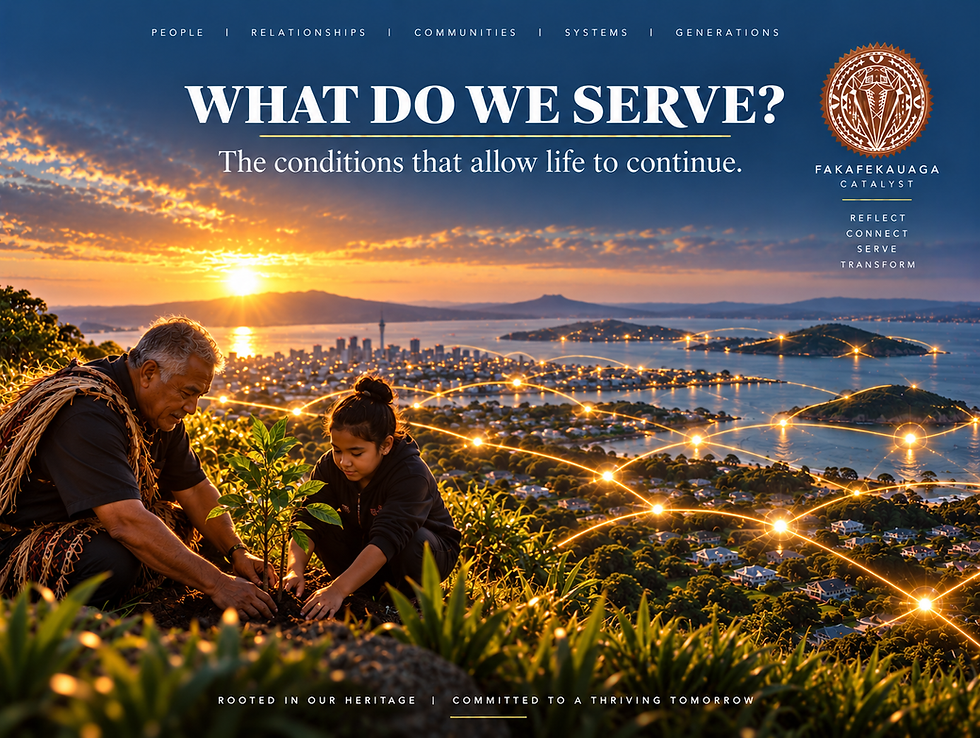
Falalahemotu, F. & Makapatama, G. (2026). What Do We Serve? The Fakafekauaga Servantship Series — Tutala 3. FakaFekauaga Catalyst (FFC).
Finally, as with all living knowledge systems, these references are not intended as endpoints of authority but as relational anchors within an ongoing dialogue.
We encourage readers to engage these works through reflection, lived experience, and collective tutala/talanoa, allowing interpretation to evolve within your own systems, communities, and contexts.
Within Fakafekauaga Servantship, knowledge is not concluded... it is reflective.. it is evolving and it is carried forward.
FakaFekauaga Catalyst™ (FFC) – All rights reserved.
All content on this website is the intellectual property of FakaFekauaga Catalyst (FFC) and may not be copied, reproduced, or distributed without permission.


Comments